
The Short Answer
How long does Amazon ungating take? Plan on a month per brand, with a first decline already built into that number. That is our own planning figure, not a date Amazon publishes; category approval is a separate application with its own timeline. Most of the month sits on your side: the supplier, the invoice, the second try.
And there is a route with no application at all: an aged account that already holds the approval. That route starts at our aged Amazon seller accounts page.
Category Approval and Brand Approval Run on Different Clocks
Both get called ungating, which is why the timeline question gets muddled answers. Category approval, as sellers use the term, is permission to list in a whole department; brand approval is permission to list one brand inside a department you can already sell in. Same word, two different applications, two different waits.
Amazon's own page on categories and products that require approval sets out what to prepare and a review wait; it says nothing about account age changing either one, so we do not claim that it does.
Brand approval is the slow one, and it runs one application per brand. Amazon's own brand approval page is blunt about the most common way to lose a round:
"If the brand name is a product type, product description, model number, or anything else besides a brand name, your application will be declined."
When we say a month per brand, this is the approval we mean.
The Ungating Timeline: Where the Month Goes
An application looks like one form. The timeline around it has four parts:
| Part of the wait | Whose clock | What sends you back to the start |
|---|---|---|
| Getting stock you can prove you bought | Yours, and your supplier's | A distributor who will not open an account for you yet; paperwork that does not match the account |
| Filing the application | Yours | The wrong listing, or one where you find no way to apply |
| Waiting for the answer | Amazon's | Nothing to do here but wait |
| Fixing a decline and going again | Yours, then Amazon's again | The same document, resubmitted unchanged |
New sellers underestimate the first part. Distributors often want to see a sales record before they open an account, and a new seller account has no record to show. So the invoice you need for the application is the thing you cannot get yet. It is a supplier problem first, and it can outlast the application itself.
Amazon's own page on categories and products that require approval lists what to prepare before you apply: purchase invoices dated within 180 days, clear product photos, brand authorization letters where they apply, and for some categories, safety certifications or commercial liability insurance. Once that file goes in, Amazon's own listed timeline for review is two to seven business days.
When you are not the brand owner, the invoice question turns into an authorization question. Amazon wants proof of that relationship as a PDF or scanned PDF, a screenshot of an email from the brand's own domain, or "Letter head from the company holding rights to the protected brand." A letter that does not clearly name both the brand and you is a round lost the same way a mismatched invoice is.
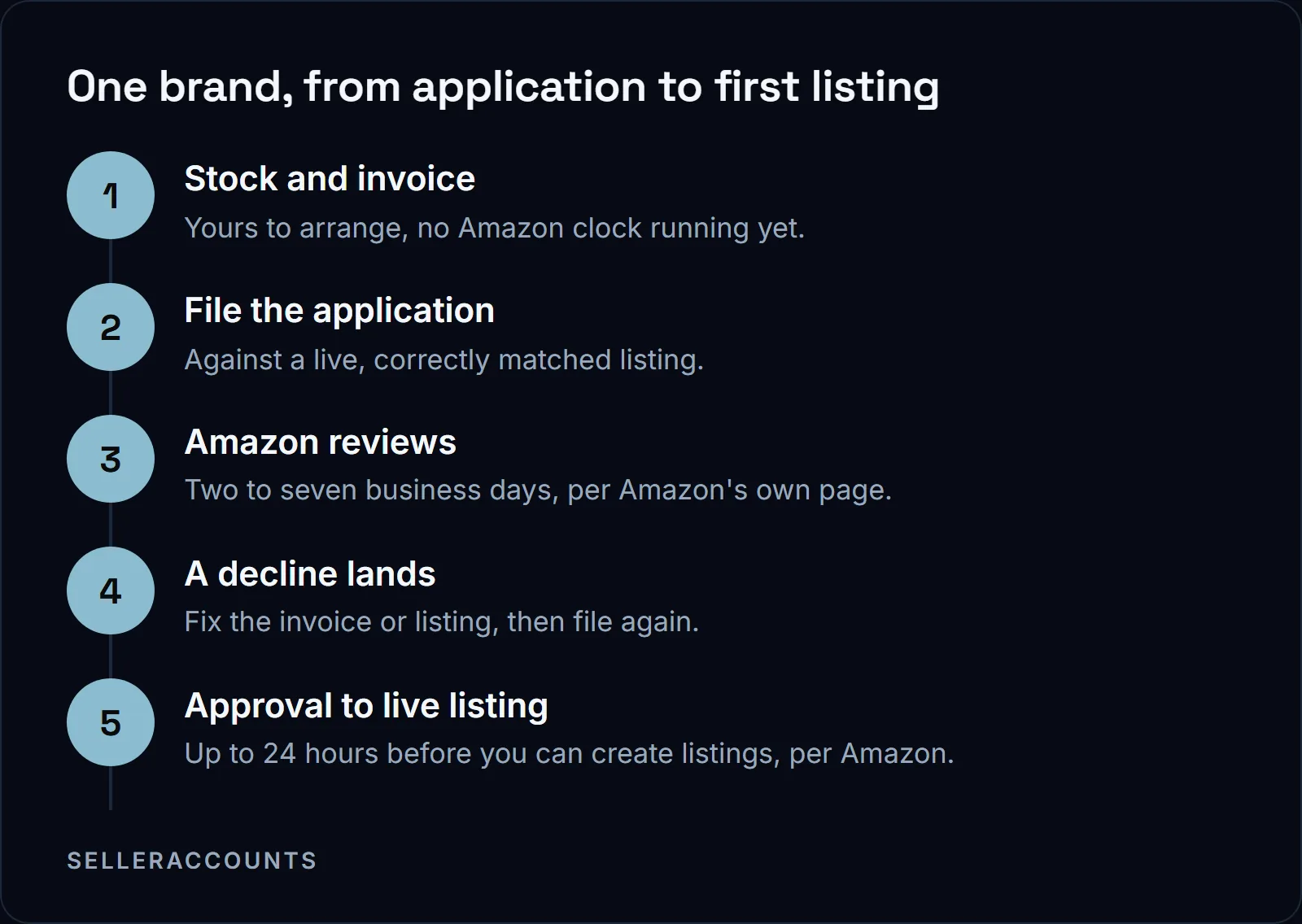
That review window is short. What stretches it to a month is not Amazon's clock, it is how many times you go around it.
Ten brands do not need ten months. The plan is the same month with the applications run side by side, so the calendar stays about the same while the money and the attention multiply. Every brand is its own stock buy and its own invoice before it is its own application, and its own round of declines after.
What Actually Makes It Faster
Leave the wait for an answer alone. The number of rounds is yours to cut, and the rounds are where the month goes.
- Get the invoice right before you press apply. Match Amazon's own list: purchase invoices dated within 180 days, and clear product photos showing all sides. Fix any gap before the first application goes in.
- Get the letter of authorization right if you are not the brand owner. Letterhead or a screenshot from the brand's own email domain, naming both the licensor and the licensee, is what Amazon checks for.
- Never resubmit a declined document unchanged. If the same invoice has been declined more than once, the invoice is the problem. Fix it with a different distributor or a different listing.
Do those and you have taken out everything you control. What is left is the wait.
The Route With No Application: An Account That Already Has It
The other way to get ungated is to skip the application. Take over an aged account that already holds the approval, and there is nothing to apply for on the brands it holds. We sell aged seller accounts, 1,700+ of them since 2020, Amazon first and now Walmart and eBay too, so this is the route we know from the inside.
Say the honest part first. Amazon's transfer help page opens with "Seller accounts generally are not transferable," and goes on:
"If the ownership of a business changes for any reason, the new owner must establish a new seller account."
We do not soften that. It is the reason to walk away from anyone offering an account as a login pasted into a chat. An account from us comes with a mutual Deal Agreement signed before any money moves, and payment upfront to a named company. Handover is 10 to 14 business days as standard. About half of Amazon transfers draw an extra verification request and run 30 to 60 days. That is the handover clock on this route, and it is one handover, however many brands the account holds.
Three Brand Approvals Come With Every Account You Buy
Every account we sell comes with three brand approvals already included, apply to sell only, and each one is named in your deal agreement before you pay. We file the invoice and the application for those three; you are not the one doing the paperwork for them. Beyond that list, a brand runs on the same clock as anyone else's application, the same month, the same rounds.
Two different things sit under the word ungated. Already ungated means the account can list in that brand today, no application at all. Apply to sell means an application still has to go in, and that is the work we do for the three brands included with an account. Which brands a given account already holds outright, versus which it has apply-to-sell access for, is on that account's own record, so bring your brand list before you buy and we check it against the account rather than promising in the abstract.
Beyond the three included, we also run brand ungating as a paid service, on an account bought from us or on one you already own, so a brand past that list still does not have to be an application you file yourself.
The replacement worth chasing beyond those three is not just a brand name, it is an approval that is hard to get from zero. Amazon ties each one to a document, a metric, or a wait, never to age:
| Approval | What Amazon requires | The wait |
|---|---|---|
| Seller Fulfilled Prime | 90 days of your own shipping history, at least 100 seller-fulfilled packages in that window, cancellation rate under 2.5%, valid tracking above 95%, late-shipment rate under 4% | A four-week trial you can still fail |
| Hazmat (dangerous goods) | An automatic waitlist once inventory is reclassified as hazmat | Typically about five business days, and Amazon says enrollment cannot be expedited |
| Amazon Renewed | Invoices proving purchase volume over the last 90 days, an order defect rate capped at 0.8% | "We aim to review all applications within 10 days of submission and respond accordingly." Processing times vary. |
None of the three is decided by account age on paper. What age actually buys is a shortcut: an account can already hold the approval, so there is no waitlist, trial or invoice review left to run. Which of these a specific account holds is on its own record, named only where it is true, never promised as a property of every aged account.
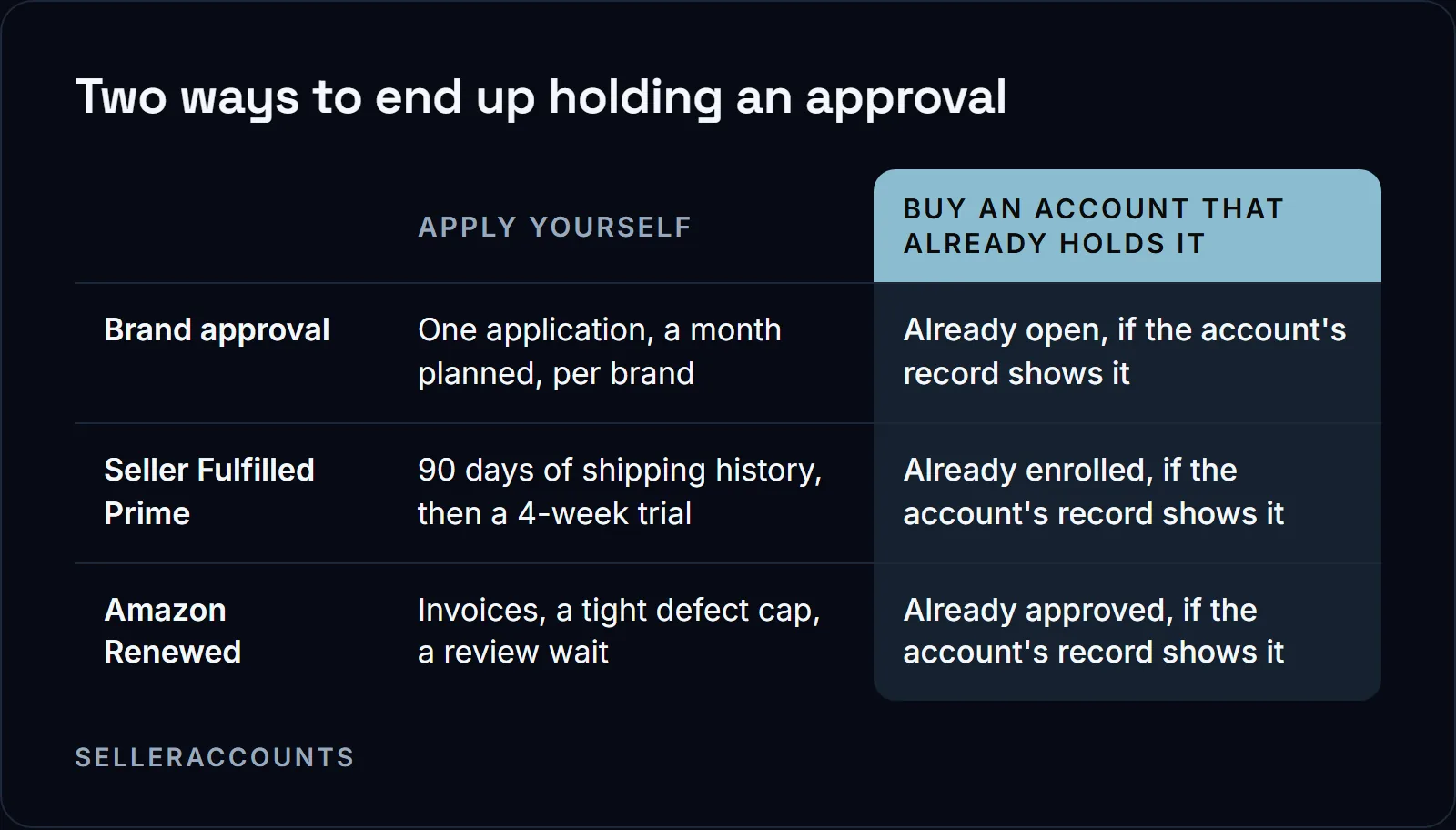
Every row carries the same caveat: only if the account's record shows it. Bring your own brand and program list to the aged Amazon seller accounts page and we check it against the account, rather than buying on the idea of an aged account in general.
Once the account is yours, list what it already holds first, including the three brand approvals we filed for you as part of the deal, then start filing for what's left. The plan for the first 30 days in how to protect your Amazon account after transfer covers when to start those applications and in what order. The full comparison of the two starting points is in aged Amazon account vs. new account, and the handover itself, step by step, is in how an Amazon account transfer works. The terms, from the Deal Agreement to payment, are on how buying works.
If you are reading from the other side, with an account that holds approvals and a plan to leave Amazon, that is our sister brand's lane: Cash For Stores (cashforstores.com) buys accounts from their original owners. Everything on this site is for buyers.
FAQ
How long does it take to get ungated on Amazon with a brand new account?
Budget the same month per brand, then add time at the front for the supplier, because that is the step a brand new account cannot shortcut. Open supplier accounts before you need the invoices, and apply first for brands whose distributors will already sell to a new business. If nobody will, that is the point to price the account route instead.
Does Amazon publish a committed review window for ungating applications?
Amazon's page on categories and products that require approval lists a review step of two to seven business days once your file is complete, and Amazon Renewed separately says it aims to review applications within 10 days, though it adds that processing times vary. Neither number is a promise for a specific brand, and Amazon publishes no committed window for brand ungating itself. That is why we plan a month rather than quote a date.
What should I do if my ungating application keeps getting declined?
Change something before you file again, because sending the same document again is asking the same question again. After a month of proper attempts on one brand, change the plan itself: a different supplier, a different brand, or an account that already holds it. The month is a budget, and once it is spent, the honest move is to stop spending on that brand.
What happens to the stock I bought for the application if the brand never opens?
Order the smallest real quantity that gets you a proper invoice, and treat the launch order as a separate buy that happens after the approval. Until then you are holding units you cannot list on Amazon. If the brand stays closed, a small order going to another channel is a small problem, and a pallet is not.
If I buy an account, do I still have to wait for ungating on anything?
Yes, on anything past the three approvals already written into your deal agreement. Send us your brand list before you buy, we check it against the account's own record, and you know before you sign what is already open versus what still needs an application. Use the handover window to start sourcing invoices for that second list.
How do you buy an aged Amazon account, and how long does the handover take?
The mutual Deal Agreement is signed first, and no money moves before it is. Payment is then made upfront to a named company by wire, ACH, card or crypto, with a 3% card fee for US buyers and 4.5% outside the US. After the transfer, support runs for 30 days or until your first sale, whichever comes first. We do not publish prices, so for the numbers on a specific account start at the aged Amazon seller accounts page or how buying works.
Related pages
Ready to Scale Your Amazon Business?
Book a free demo call and we'll screen-share real accounts live to find the right match for your business. No screenshots, no guesswork.
Book Your Demo