
The Quick Answer
Buy an aged Amazon account and you take over a store with years of trading behind it: sales history, seller feedback, and whatever approvals its own record already carries. Those are the approvals that need shipping volume, invoices or clean metrics a new account does not have yet. A new account starts with none of that and spends 12 to 24 months building sales history, FBA capacity and distributor trust from zero. Buy aged when the bottleneck is approvals and history you don't have yet; start fresh when you have the runway to build both yourself.
- The catch: you inherit the account's past, so you inspect it live before you pay
- The rule: a transfer is a business changing hands with Amazon re-verifying the new owner, never a password passed to a stranger
| Day one | New account | Aged account |
|---|---|---|
| FBA capacity | Built from zero over the first year or two | Its restock limits and storage allowance, shown to you live before you buy |
| Brand approvals | None. Every gated brand is its own application | Three named in your deal agreement, apply to sell. Anything else is on that account's own record |
| Distributor relationships | None | The ones account history unlocks, with that history on the record |
| Payout schedule | Settled every two weeks, held until seven days after delivery | The same. Amazon does not shorten the hold because an account is older |
| What you inherit | Nothing, good or bad | Whatever came before, so you inspect it live |
Is It Legal to Buy an Aged Amazon Seller Account?
What changes hands is the business behind the account, under a signed deal agreement, the contract every buyer signs, with Amazon re-verifying the new owner. Amazon's own pages say a seller account is not transferable and that a new owner of the business must open a new seller account. We never soften that.
Amazon's help page "Can I transfer my seller account?" is direct about it:
"Seller accounts generally are not transferable. Seller accounts provide access to the tools and resources that sellers use to list their products and manage their orders. Seller accounts also include account activity history and buyer feedback. Every seller on Amazon must have a seller account and an agreement with Amazon that establishes the terms under which the seller lists and sells their products."
"If the ownership of a business changes for any reason, the new owner must establish a new seller account."
Its user-permissions page says the same thing without the softer wording:
"Although you can add users to your Professional seller account as secondary users, you can't transfer the account. If the business ownership changes, the new owner should establish a new seller account in their name."
That rule is Amazon's own policy, not a law. The law in the picture is the INFORM Consumers Act, the federal law that makes a marketplace collect and verify a high-volume seller's bank, tax and contact details. What we run is a documented change of business ownership. The deal agreement is signed and paid before anything moves. Then email, two-factor and ownership data are migrated in sequence while the new owner passes Amazon's re-verification under that Act. Amazon re-checks all of it in the new owner's name: ID, business address, bank account, email, phone, tax ID and point of contact. That is the reason to walk away from anyone offering a login pasted into a chat. Six years of transfers and 1,700+ accounts sold are behind that process.
The Approvals a New Account Has to Earn From Zero
Amazon ties its hardest approvals to documents, metrics or a wait, not to account age. What an aged account changes is that it can already hold one of these, so there is nothing left to apply for.
| Approval | What Amazon requires | The wait |
|---|---|---|
| Seller Fulfilled Prime (Prime orders you ship yourself) | 90 days of your own shipping history with at least 100 seller-fulfilled packages, a cancellation rate under 2.5%, valid tracking above 95%, late shipment rate under 4% | A four-week trial you can still fail |
| Hazmat (dangerous goods) | A place on the program waitlist; inventory reclassified as hazmat adds you to it automatically | Typically about five business days; Amazon says enrollment cannot be expedited |
| Amazon Renewed (pre-owned and refurbished products) | For a reseller or distributor, invoices proving $50,000 in purchases over the past 90 days for US and Canada sellers, plus an order defect rate of 0.8% or less in the trailing 60 days | Amazon aims to review applications within 10 days, though it says processing times vary |
Three brand approvals, apply to sell only, come with every account we sell, each one named in the deal agreement. Apply to sell means invoices have to go in before the approval, and only then can the account list the brand; we do that work for you. Already ungated means the account can list the brand today. Which of the harder programs above a specific account already holds, if any, is on that account's own record. Bring your list of brands and programs before you buy and we check it against the account rather than promise it in the abstract. The accounts we have now are on the aged Amazon seller accounts for sale page.
How Long Each Route Takes
On the aged route the clock is the handover: 10 to 14 business days on about half of transfers, 30 to 60 days on the other half. On the new route there is no handover; the clock is the year or two of building.
| Milestone | New account | Aged account |
|---|---|---|
| Getting started | Register, wait for category approval, start with no sales history | Live demo, sign the deal agreement, pay |
| Standard case | 12 to 24 months of building before there is a record to show | 10 to 14 business days, on about half of transfers |
| Extra verification | No published timeline: Amazon's registration requirements page lists the documents it may ask for, not the days | 30 to 60 days, when Amazon asks for one more check, on the other half |
| Brand approvals | One application per brand, each a 2 to 7 business day Amazon review, and a first decline is normal | Three included, apply to sell, named in the agreement before you pay |
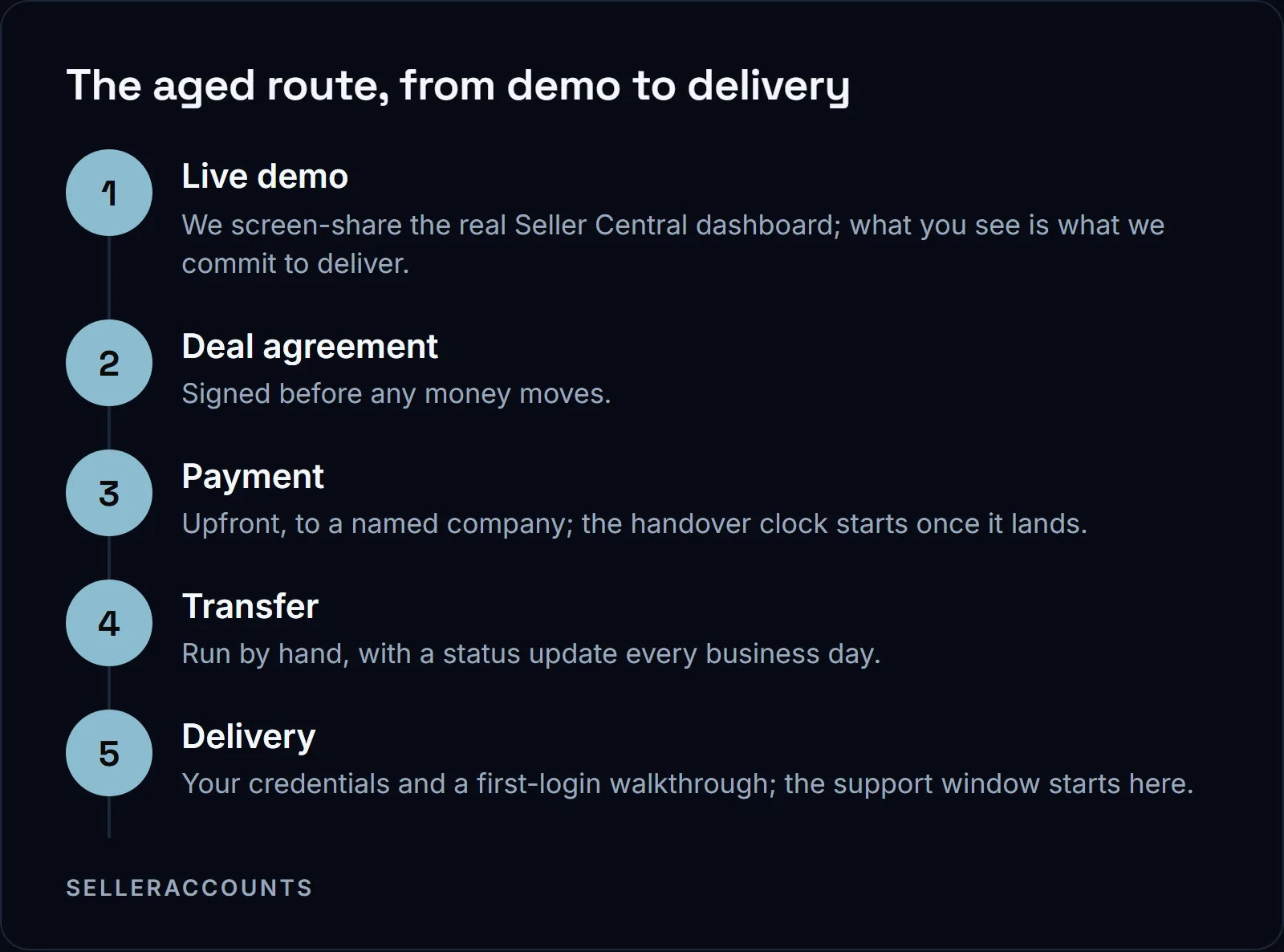
The full sequence, from the live demo to delivery, is on how buying works.
Amazon's Payout Schedule Does Not Get Better With Age
Every Amazon account, new or a decade old, has settled on the same schedule since March 2026. Money moves out every two weeks. Each order's money is held until seven days after it is delivered. Amazon's own help page calls that the DD+7 reserve policy, delivery date plus seven days. Amazon may extend that period after assessing your risk and historical performance, and it never shortens it because an account is older. So the schedule is not a reason to prefer one account over another.
Amazon's own list of what gets you paid faster is dispatching fast, confirming dispatch, valid tracking numbers, an integrated carrier and faster delivery. Account age is not on that list.
Walmart and eBay run on their own schedules:
| Marketplace | Payout cycle | Holds |
|---|---|---|
| Amazon | Settles every two weeks | Each order held until seven days after delivery, on every account |
| Walmart | A fixed two-week cycle, closing on alternate Fridays | An account-level reserve is normal, plus a rolling delay for new sellers |
| eBay | Daily by default | Held until delivery is confirmed on new, idle, recently suspended or flagged accounts |
If you are weighing more than one marketplace, see Buy a Walmart Seller Account and Buy an Aged eBay Seller Account.
Before You Buy Any Aged Account
Whoever you buy from, including us, settle the agreement in writing and check the rest live on a screen-share, never from screenshots:
- Who you are paying, and what they sign - a written agreement with the seller you pay, naming the account and everything promised with it, or there is no counterparty if something goes wrong
- Brand approvals, in the approvals section - not a list in a message. Which brands are already open, which are apply to sell, and are they still active
- Account health and the notification history - warnings, IP complaints, A-to-Z claims, and what was done about them
- Restock limits and storage allowance, current - not what the account carried two years ago
- Any harder program on the record - hazmat, Seller Fulfilled Prime, Amazon Renewed, named only where the account holds it
Whatever you see on that screen-share is what you're buying. On our side, the account as inspected on the demo is what we commit to deliver in the deal agreement, not what's remembered a week later.
What Comes With an Account You Buy
Every buyer signs a deal agreement: it names the account, locks the price and timeline, and lists every brand we promised, so there is no argument later about what was agreed. An Asset Purchase Agreement, a contract carrying the seller's representations and warranties on the account, is available on request.
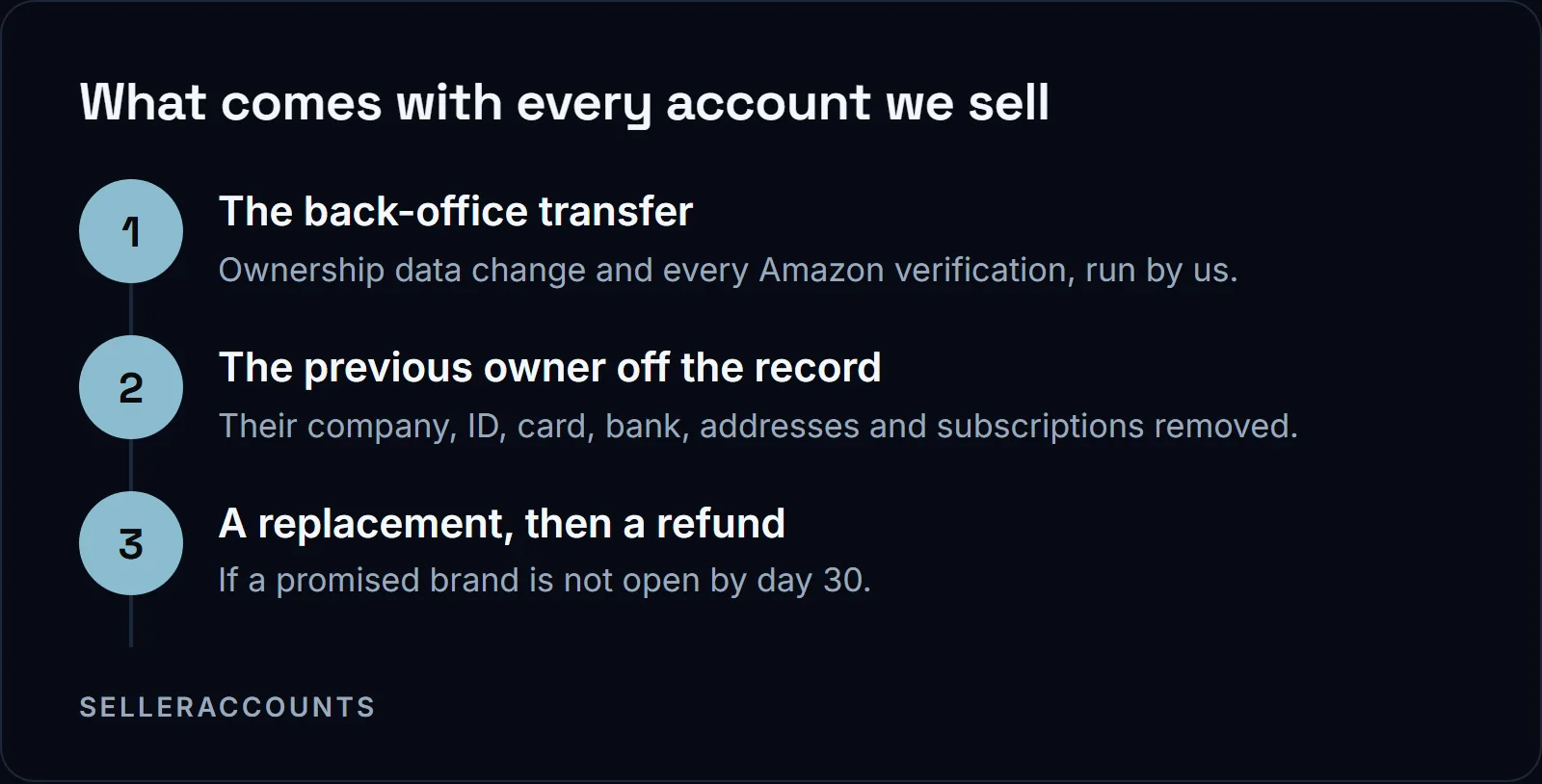
Post-transfer support runs 30 days from delivery or until your first sale, whichever comes first, written into the agreement. It covers verification re-submissions, transfer-related suspensions and login help, not anything your own selling triggers. If a brand we promised is still gated at delivery, we keep working on it.
Who Should Buy New vs. Aged
The choice comes down to runway: how long you can spend building approvals and history before you need the account working.
| If this describes you | The route to take |
|---|---|
| You have a year of runway and are in no hurry for revenue | Starting fresh |
| Your model does not need brand approval, generic private label for example | Starting fresh |
| You need approvals and capacity now, not a plan to build them over the next year or two | An aged account |
| Your model needs approvals a new account cannot realistically apply for yet | An aged account |
| You are an experienced seller adding a second or third account | An aged account |
The Bottom Line
If the account in front of you already holds what you would spend a year or two applying for, an aged account is the shorter path. Check it on the demo before you pay: Seller Fulfilled Prime, Renewed, hazmat or a gated brand, on its own record. What moves the price on a specific account is its own page: how much does an aged Amazon seller account cost, or start at aged Amazon seller accounts for sale to see what's in stock.
If you are reading this from the other side, with an account that already holds approvals and a plan to leave Amazon, that is Cash For Stores' lane at cashforstores.com. It buys accounts from owners exiting the marketplace; everything on this site is for buyers.
FAQ
What is the difference between an aged buyer account and an aged seller account?
Everything. A buyer account is a shopper login with old orders on it, and it cannot sell anything. This post, and everything we sell, is about seller accounts: Seller Central, FBA, brand approvals, sales history.
Can I use the account immediately after the transfer?
Yes. At delivery you get a file with your credentials and a portal walkthrough for your first login. One job is yours from day one: the phone number we put on the account has an expiry date, written in your delivery file. Replace it with a number that has never been used on any Amazon account.
What happens if Amazon asks for extra verification during the transfer?
We handle every Amazon request for you. If Amazon asks for a live video verification call, we coordinate it with your designated point of contact.
What happens if the account is suspended after handover?
It depends on what caused it. A suspension tied to the transfer itself, an Amazon check that has to be redone for example, sits inside the support window and we handle the re-submission with you. A suspension your own selling triggers sits outside it, and we do not offer reinstatement as a service.
Can one person legitimately run more than one Amazon seller account?
Amazon's own policy allows more than one account where there is a legitimate business need and all of your accounts are in good standing. What we control on our side is keeping every account we deliver on its own clean device profile, phone number, bank details and business identity from day one, never shared with another account you run.
How much does an aged Amazon seller account cost?
We don't publish prices, because what an account is worth depends on its brand approvals, FBA capacity and sales history, and those differ store to store. What moves the number is broken down on how much does an aged Amazon seller account cost, and every account is priced individually, so you see the account and its price before you sign anything.
Related pages
Ready to Scale Your Amazon Business?
Book a free demo call and we'll screen-share real accounts live to find the right match for your business. No screenshots, no guesswork.
Book Your Demo