

The Quick Answer
Check it with your own eyes on a live screen share before you pay for an aged Amazon account to start or grow your business. Look at the Account Health page, every notification, sales history and feedback, which brands show "Sell this product", and what the signed agreement names. On every account we sell, we screen share the real Seller Central dashboard before you pay.
Screenshots are not a check. A spreadsheet of numbers is not a check. A promise in a chat is not a check. A live dashboard where you choose what gets clicked is.
We have sold 1,700+ aged Amazon, Walmart and eBay accounts. This is the list we would want a buyer to run on us.
What Should You See on the Live Demo?
You should see the real Seller Central dashboard, live, with the seller clicking where you ask. That means the Account Health page, the notifications, sales history, feedback, brand approvals and FBA capacity. If a seller offers screenshots or a recording instead of a live session at a set time, treat that as a no.
With us, the next step for an interested buyer is a live walkthrough of that specific account over Zoom, at a set time. We screen share the dashboard itself. Our own process states it plainly:
"The account as inspected on that demo is what we commit to deliver."
Bring your list before the call. Tell us which brands or product codes you plan to sell, and we check them against the account and come back with a result for each one. Send it as a spreadsheet or plain text. We have taken lists of several thousand product codes and come back with a match.
Run the checks in this order, so nothing gets skipped while the conversation moves on:
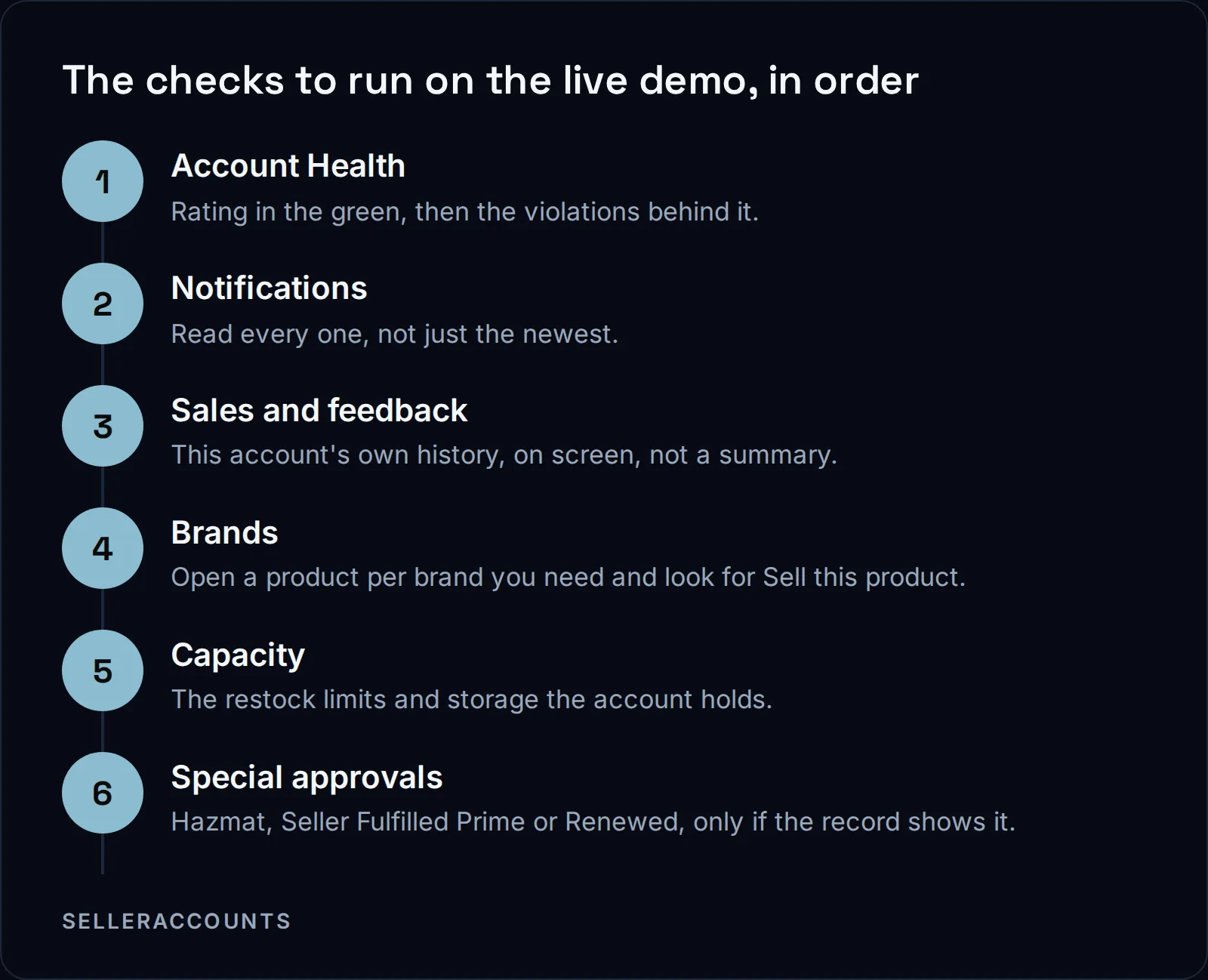
How Do You Check Amazon Seller Account Health Before Buying?
Open the Account Health page on the demo and read the Account Health Rating. Amazon scores it from 0 to 1,000: 200 and above is green, Healthy; 100 to 199 is yellow, At Risk; 99 or lower is red, Unhealthy. The score reflects the last 180 days, so read every notification behind it too.
The Account Health Rating (AHR) is Amazon's score for how close an account is to deactivation under its selling policies. It is shown on the Account Health page for each store the account sells in.
0 to 1,000
the range of Amazon's Account Health Rating
200
where green, Healthy, starts
180 days
the window the rating looks back over
Three things from Amazon's Account Health Rating program policy matter to a buyer:
- Violations cost points. A new policy violation lowers the score. Fixing it earns points back.
- Repeats are the danger. An account can be at immediate risk of deactivation once it hits the maximum number of repeat violations for one policy in 180 days. For higher severity violations that can be as low as two.
- Orders count. Amazon also grants points when a minimum number of orders are filled, and every new seller starts at 200. So the score on an aged account reflects how it has actually sold and behaved over the last six months.
Green with an open violation listed underneath is not the same as green with nothing listed. Ask the seller to open each item. If a notification is about a policy, a brand complaint or a verification request, ask what happened and how it was closed.
Which Brands Can the Account Really Sell?
Only the brands where the account shows "Sell this product" today. Name the brands or product codes you plan to sell and have them checked against that account. Already ungated means the account can list the brand now. Apply to sell means invoices still have to go in, and the account lists only once Amazon approves.
Here is how we judge a brand open: we check twenty of that brand's products on the account and count how many show "Sell this product". If at least half do, the brand goes on the open list.
A brand list is a snapshot. Amazon changes its rules and brands set their own, so a brand open when we checked can close later. Before you list under any brand, open one of its products on the account and confirm it still shows "Sell this product". Our guide on how to check if a brand is gated walks through it.
What is promised is a different thing from what is shown:
- Three brand approvals come with every account we sell. They are apply-to-sell approvals, each named in the Deal Agreement.
- The account's own approvals come from its history. An aged account often already carries dozens of them, and we show them live before you buy. We never promise a number for one account.
- Hazmat, Seller Fulfilled Prime, Amazon Renewed. A new account has to qualify for each of these from zero, because Amazon ties them to documents, metrics or a waitlist, not to account age. We name one only where that account's record carries it, and our account listing shows the flag only when the record says yes.
If a brand we promised is still gated at delivery, we keep working on it, and a 30 day clock runs from delivery: a replacement account first, then a refund, if it is not open by day 30.
What Should Be in Writing Before You Pay?
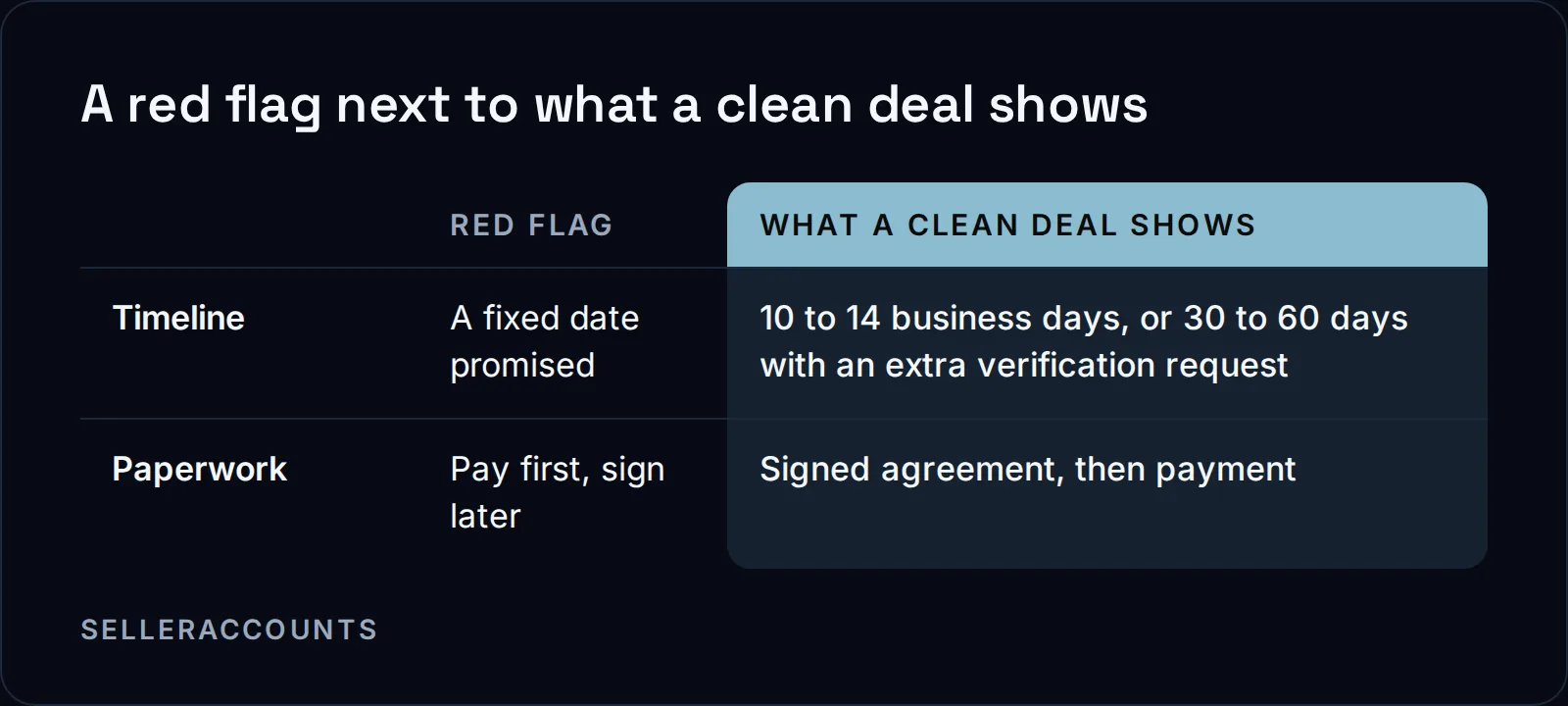
The account, the price, the payment terms, the timeline, every brand promised, the support window, and the replacement and refund terms. With us that document is the Deal Agreement, signed by both sides before any money moves. If a seller wants payment before anything is signed, stop there and walk away.
The Deal Agreement is the contract every buyer signs with us. An Asset Purchase Agreement is available too, but only when a buyer asks for it.
Then check who you are paying. With us it is a named company, Seller Solutions Global LLC, paid upfront by wire, ACH, Zelle, card through Stripe, or crypto in USDT or USDC only.
Check the timeline in writing, not on a call. For an Amazon account, our standard handover is 10 to 14 business days. About half of transfers get an extra verification request from Amazon and run 30 to 60 days. Anyone who promises a fixed date is promising something Amazon decides.
Check the support window. Ours ends 30 days after delivery or at your first sale, whichever comes first. It covers verification re-submissions, transfer related suspensions and login help, not anything your own selling triggers.
One gap other checklists leave: they tell you to audit profit, tax returns and supplier invoices. That fits buying a whole business. We sell the account, not a running business, and inventory or active listings are not included unless the deal states them. So your check is the account's record, and your profit plan is your own. Starting prices are on our price page, and the exact figure for an account comes with its details, on the call.
Aged Amazon Account Red Flags
A red flag here is anything that stops you seeing the account for yourself, or a promise no seller can keep.
| Red flag | Why it matters | What to ask for instead |
|---|---|---|
| No live session | You cannot tell whose dashboard a screenshot came from | A live screen share at a set time |
| Health rating not shown | The score is Amazon's own read on deactivation risk | The Account Health page, opened in front of you |
| Payout speed sold as a benefit | Amazon holds each order until seven days after delivery (DD+7) on every account since March 2026, and age does not shorten it | Approvals the account's record actually carries |
| "Ungated" with no proof | Apply to sell and already ungated are different things | Your brands checked product by product |
| Old owner's details stay on | Their name, bank or card on the record is not a handover | Their company, ID, card and bank off, yours on |
| "No verification needed" | Amazon verifies updated seller information | A plan for verification and a realistic timeline |
| A promise that Amazon will never act | Nobody controls what Amazon decides | A written remedy: replacement first, then refund |
DD+7 means delivery date plus seven days: Amazon keeps each order's money until a week after it arrives. Amazon settles every two weeks. That is true on an aged account and a new one alike, which is why payout speed is never a reason to buy an aged Amazon account from us.
Is Buying an Amazon Seller Account a Scam?
It can be, when you pay for an account you never saw live on a promise nobody signed. It is not when you inspected the account yourself, the agreement names what you get, and the change of owner goes through Amazon's own verification.
Does Amazon Allow Buying a Seller Account?
Amazon's help page on transfers says "Seller accounts generally are not transferable," and that a new owner of a business must establish a new seller account. For a buyer, that means the risk is yours to weigh before you pay, and the change of owner still has to pass Amazon's verification of the updated seller information.
We will not pretend otherwise. Our detailed answer is in can you transfer ownership of an Amazon seller account you bought.
What we do is make the change in the open. The INFORM Consumers Act is a US federal law, in force on Amazon since June 27, 2023, that puts verification duties on Amazon and on high-volume sellers. Amazon's INFORM Act page says:
"all high-volume third-party sellers are required to keep their information up to date and notify us when their information changes. We must then verify any updates made."
So on a transfer, the ID, business address, bank, email, phone, tax ID and point of contact all go through Amazon's checks again. That is why about half of our Amazon transfers take 30 to 60 days. The same page says an account can be deactivated for not completing verification or the yearly certification. More on what you provide is in our INFORM Act verification guide.
We do the handover by hand: verifications, cleanup of the previous owner's addresses, cards and subscriptions, email, 2FA and phone, and the ownership data change. We handle every Amazon interaction and send you a status update every business day. The full path is on how buying works, and accounts in stock are on aged Amazon accounts for sale.
FAQ
Do I need a company before buying an aged Amazon account?
Yes, and it matters which one. The company that goes inside the account must be clean, never used on Amazon before, with a clean EIN, because Amazon checks the tax ID. If the EIN is not in Amazon's system yet, that alone can add three weeks to a month, so a company formed at least 30 days before the purchase helps.
What if a brand you promised is still gated at delivery?
The remedy is set out in the brands section above. Only the brands written into your Deal Agreement carry that promise.
Should I check the account again after delivery?
Yes. Read the Account Health page and recheck each brand you plan to sell. Our guide to the first 30 days after transfer covers the rest.
Can a suspended seller buy an account from you?
No. We do not sell a clean account to a suspended seller, and we do not offer reinstatement as a service.
What if the seller will not open a notification I ask about?
Treat it as a red flag and stop. A notification can be a policy warning, a brand complaint or a verification request, and each one tells you something about the account. A seller with a clean account has no reason to keep it closed.
Related pages
Ready to Grow Your Amazon Business?
Book a free demo call and we'll screen-share real accounts live to find the right match for your business. No screenshots, no guesswork.
Book Your Demo