
Can You Transfer Ownership of an Amazon Seller Account You Bought?
Amazon's help pages say no: you cannot transfer a seller account, and if ownership changes, the new owner must establish a new seller account. What actually happens when a bought account changes hands is different: its legal entity, tax ID, bank, email, phone and point of contact update to you, and Amazon then checks the new details.
What Amazon's Own Pages Say
Two Amazon pages cover this, and they agree. The account transfer help page:
"If the ownership of a business changes for any reason, the new owner must establish a new seller account."
The account permissions page says the same thing without any softening language:
"Although you can add users to your Professional seller account as secondary users, you can't transfer the account. If the business ownership changes, the new owner should establish a new seller account in their name."
Amazon's transfer help page describes no transfer option inside Seller Central, and names no exception for a disclosed or documented change. The Business Solutions Agreement, the contract every seller accepts, treats the agreement itself the same way:
"You may not assign this Agreement, by operation of law or otherwise, without our prior written consent."
The one carve-out in that clause covers moving the agreement to your own affiliate company, not a sale to an outside buyer, and you stay liable for anything that happened before the move. Read the Amazon transfer help page yourself before relying on anything else written about this.
What If You Buy the Company That Owns the Account?
Amazon's help page does not treat that as a different case: an ownership change of the business, for any reason, means the new owner establishes a new seller account. The Business Solutions Agreement allows an assignment to one of your own affiliates on notice to Amazon, and anything else needs Amazon's prior written consent.
The question comes up because buying the company, rather than the account, is the structure most guides on this search point at. A lawyer will paper the deal, but no law firm logs into Seller Central and executes the changes. How you structure a purchase is a question for your own lawyer, and it does not change what Amazon's pages say.
How the Ownership Transfer Actually Runs
The ownership change is not one action. It is a set of details coming off the previous owner's record and going back on in the new owner's name. On an account we hand over, that covers:
- The legal entity and the tax ID on the account.
- The bank account and the payment card, replaced with details never used on Amazon before.
- The login email, a separate address set up for the account.
- Two-factor authentication, reset during the transfer and moved onto your own authenticator app at delivery.
- The phone number, replaced with one never used on Amazon before.
- The business and return addresses.
- The point of contact, the person Amazon deals with on the account.
That is the whole change. What takes the time is Amazon checking it.
Why Does Amazon Re-Verify You After a Purchase?
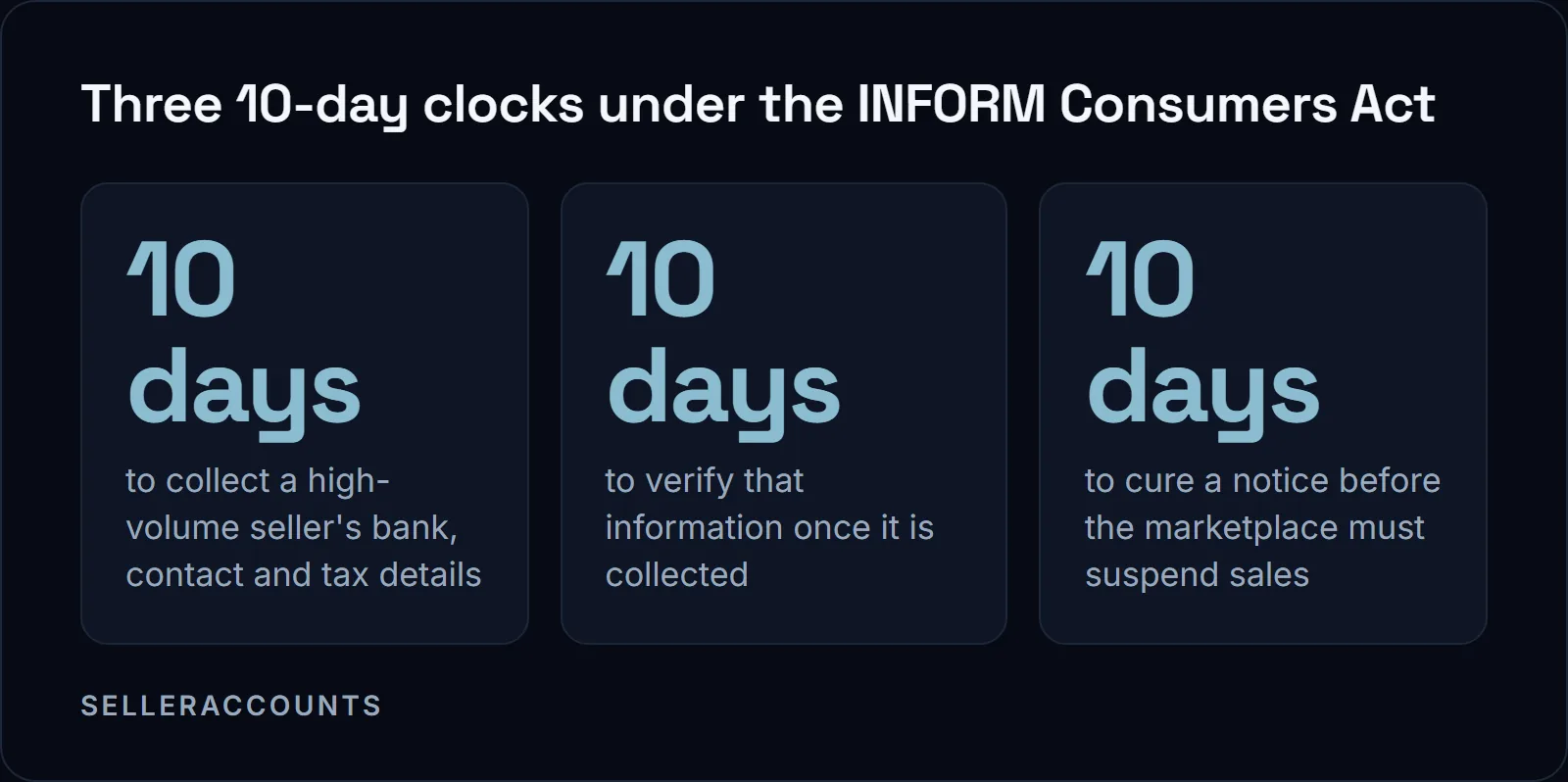
Amazon re-checks a bought account's information because of the INFORM Consumers Act, a federal law that makes marketplaces verify who is really behind a high-volume seller account. The law defines that seller by a sales and revenue threshold, not by how long the account has existed, and it applies whether you bought the account or built it yourself.
The INFORM Consumers Act sets its own bar for a "high-volume third party seller": "200 or more discrete sales of new or unused consumer products AND $5,000 or more in gross revenues, in any continuous 12-month period during the previous 24 months."
Once a seller crosses that line, the marketplace has to collect and verify bank, contact and tax information, and suspend future sales activity if it never arrives. An ownership change resets this check against the new owner's details instead of the previous owner's, which is why a bought account goes through it again.
How Long Does It Take?
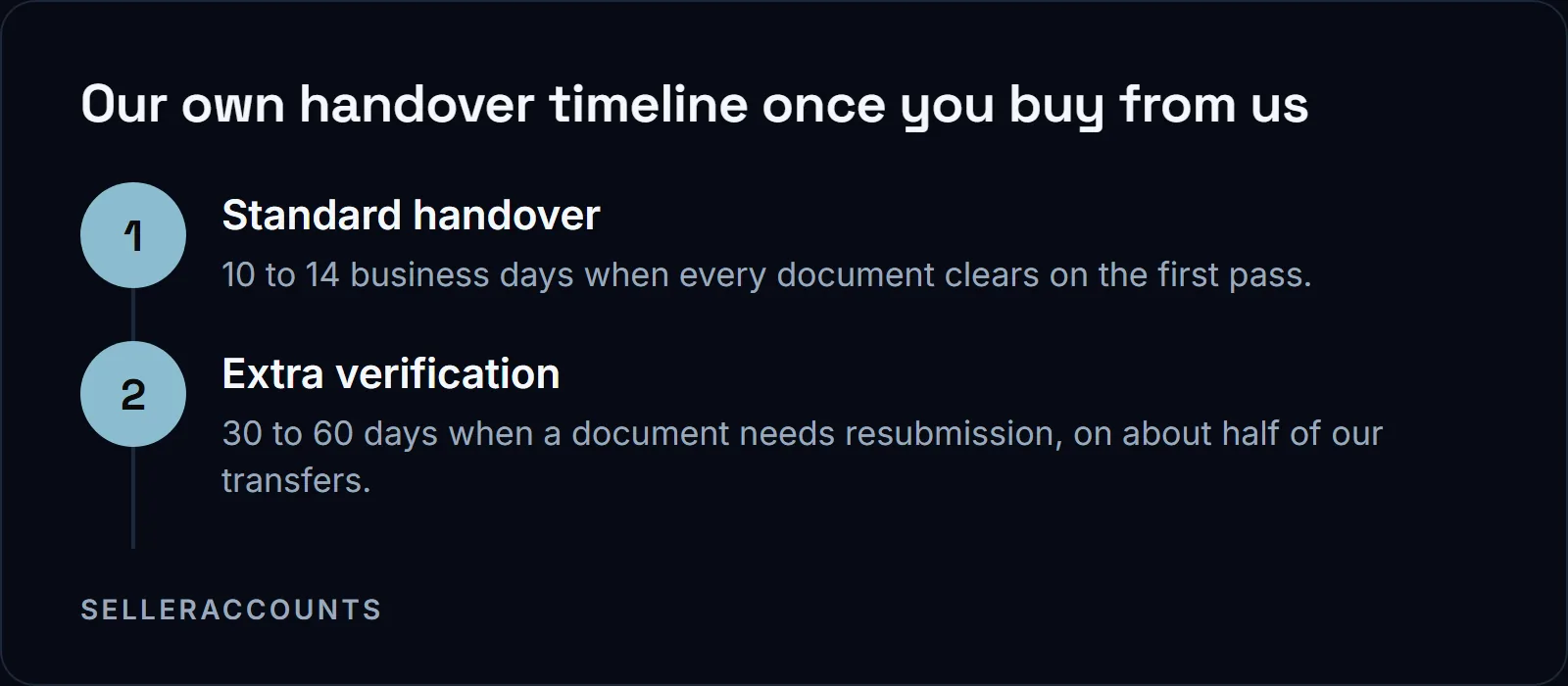
Our own standard handover on an Amazon account is 10 to 14 business days once every document clears on the first pass. About half of our transfers get an extra request from Amazon, usually a document needing resubmission, and those run 30 to 60 days instead. Neither figure is something Amazon publishes; it is what we track across our own transfers.
What Comes With an Account You Buy From Us
We have sold 1,700+ accounts since 2020 and run that change on every one. What the live demo shows is what you get: trading history, seller feedback, and the brands and categories already ungated on the account. Three brand approvals come on top of that, apply to sell only, each named in the deal agreement.
We file those three applications for you. Any other approval, Hazmat, Seller Fulfilled Prime, Renewed, or a specific gated brand, is named only where that account's own record carries it.
What does not come with it: the EU and UK marketplaces, which we close before handover because they are too complicated to transfer. The previous owner's company, ID, cards, addresses and subscriptions come off the record as part of the change.
Once the account is yours, the first 30 days after transfer covers the security setup worth doing before you list anything.
What Puts a Bought Account at Risk?
Three things on the record, and none of them is the account's age: the previous owner's details left behind, a verification nobody answers in time, and a service phone number that stops working. Behind all three sits Amazon's own rule that an ownership change means a new account, which no handover erases.
All three are the transfer's job, and all three are why a login pasted into a chat is not a purchase.
Sellers on Amazon's own forums put the first one bluntly:
"If you fall for one of those online dudes that promise you to buy your account, please realize that your name and bank information will remain on your account and YOU will be responsible for all violations and charges."
That is written to the person selling, and it is the same fact from the buyer's side. An account still carrying someone else's company, bank details and addresses is not yours in any way that matters, and clearing them is part of the ownership change rather than something to tidy up later.
The second is a verification nobody answers in time. Only one of the three clocks above runs against the account holder, the 10 days to answer a notice before the marketplace has to suspend future sales activity, and it runs whether or not anyone is reading the account's email. Someone has to be watching that inbox from the day the change starts.
The third is the phone number. At delivery the account already has a live number on it, so you can log in on day one. That number has an expiration date, which is written in your delivery file. Replace it with a number that has never been used on any Amazon account, buyer or seller. If ours expires while it is still on the record, Amazon cannot reach you for the next verification and the account can lock.
What We Do on the Handover
We do the handover by hand, including the anti-linking setup, meaning the device, IP address, bank and phone details that Amazon uses to tie two accounts together are new. We handle every Amazon interaction and send a status update every business day. The walkthrough, from the live demo to the credentials file, is in how an Amazon account transfer works, step by step.
Our transfer form asks for your entity details, a photo ID and a bank statement. If one of those is not ready, send the form with the documents you do have and send the missing one after, rather than holding the whole file while a bank statement prints.
If you are on the other side of this, holding an account you want out of rather than one you just bought, that is the lane for our sister brand, Cash For Stores (cashforstores.com).
What About Walmart and eBay?
eBay puts its rule in writing: you cannot sell an eBay account or change its ownership. Walmart is a gap in our sources rather than a rule, because none of the Walmart pages we quote, including its own seller registration guide, covers an ownership change. We sell and transfer accounts on both marketplaces, on their own clocks.
| Marketplace | What its own page says about an ownership change | Our own handover clock |
|---|---|---|
| Amazon | The new owner must establish a new seller account | 10 to 14 business days standard, 30 to 60 days with extra verification |
| Walmart | Not covered by any Walmart page we quote here | 2 to 4 weeks standard, 4 to 8 weeks in practice |
| eBay | You cannot sell an account or change its ownership, and attempting it risks restrictions, suspension or removal | 2 to 3 weeks standard, 3 to 5 weeks in practice |
eBay's own words, from its help page:
"In the interest of protecting our buyers and sellers, and maintaining a safe marketplace, you can't sell your eBay account or change its ownership."
Its User Agreement carries the same rule as a bullet you agree to when you use the site:
"transfer your eBay account (including feedback) and user ID to another party without our consent;"
What eBay does publish is Team access:
"With Team access, you can grant access to your account to other eBay users by sending invites from the Team access page in My eBay."
That lets someone else work an account without the account itself changing hands, which is not the same thing as an ownership transfer. We run our own eBay handovers, and what we do not do is tell you eBay approves of it. Read can you transfer an eBay account to a new owner and decide with eBay's wording in front of you.
Before You Pay
See what an aged Amazon seller account with this already handled looks like, or check how buying works end to end.
FAQ
Can I start selling on the account while the transfer is still running?
No. Any activity on the account before the transfer completes can link the previous owner to the new one, which is the exact thing the handover is there to avoid. Wait for the credentials file and the portal walkthrough, then start. Cutting that corner does not make the transfer faster, it creates suspension risk that costs more than the days saved.
What should I check before buying an Amazon seller account?
On an account bought from us the mutual Deal Agreement is the check: it locks the account, the price, the payment terms, the timeline, every brand we promised, the support window and the replacement and refund terms, and it is signed before any money moves. Payment then goes upfront to a named company. If you are buying from a private seller instead, verify their identity and that the account is in good standing before you pay anything, and agree who is running the ownership change before the money does.
Do brand approvals and feedback carry over when the account changes hands?
Yes, none of it is rebuilt: the trading history, the feedback and everything already ungated stay on the account. The detail worth reading in the deal agreement is what happens if a brand approval we promised is still gated at delivery: we keep working on it, and the 30 day clock runs from delivery, a replacement account and then a refund if it is not open by day 30.
Do I need my own company before the transfer starts?
The account goes into your own operating company, so our transfer form asks for that company's details alongside your photo ID and a bank statement. If you do not have one yet, onboarding asks whether you will form it yourself or want us to open it for you. The card and bank details that go on the account have to be ones never used on Amazon before.
Related pages
Ready to Scale Your Amazon Business?
Book a free demo call and we'll screen-share real accounts live to find the right match for your business. No screenshots, no guesswork.
Book Your Demo