
Why Buy an Aged Amazon Seller Account in 2026?
Buy an aged Amazon seller account in 2026 for the approvals already on its record, not for how fast it pays out. A new account has to qualify for Hazmat, Seller Fulfilled Prime, Amazon Renewed and gated brand approvals from zero; an aged account can already hold some of these, shown on its own record at the demo.
An aged account is a seller account with real trading history and account health already built up, not a fresh registration starting at zero. Amazon moved every seller account onto the same settlement rhythm on March 12, 2026: in general, funds settle every two weeks, and each order is held until seven days after delivery, on every account, new or aged. Amazon's own page on the reserve says: "Your reserve period may be extended following an assessment of your overall risk and historical performance." That applies the same way whatever the account's age. Account age never shortens it.
What account age still buys is time: the years of selling history, trial periods and supplier paperwork Amazon's own programs ask for before they let a seller in.
What Does an Aged Amazon Account Actually Get You?
What an aged account gets you is a head start: whichever of Hazmat, Seller Fulfilled Prime, Renewed or a brand approval the account already holds, you inherit it at handover instead of applying for it yourself. Which of these a specific account holds is on its own record, checked before you buy.
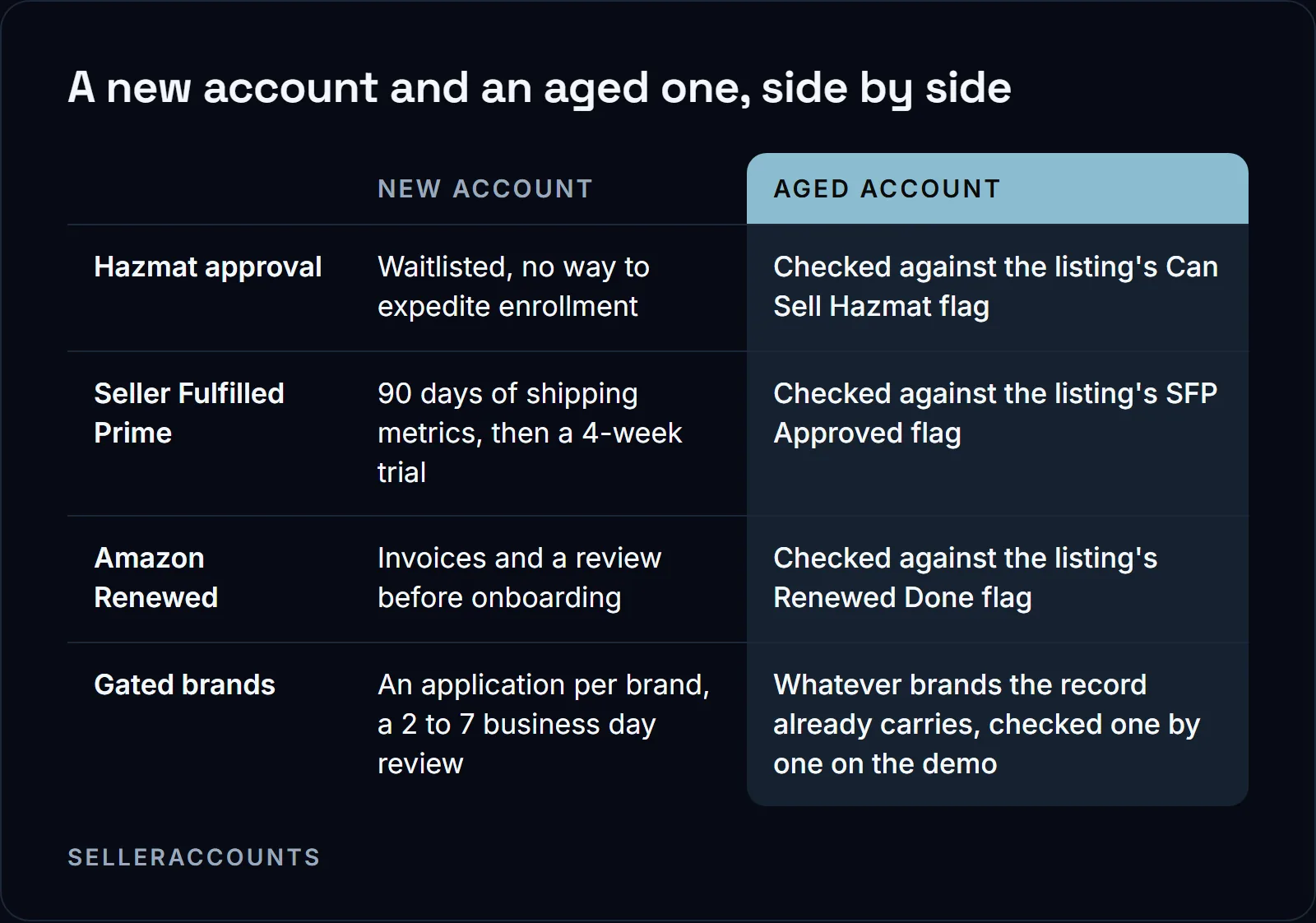
None of these run on account age by itself. Seller Fulfilled Prime is the steepest: it asks for 100 seller-fulfilled packages and set cancellation, tracking and late-shipment rates over the trailing 90 days, before a seller can even start the 4-week trial. Amazon Renewed asks for a stated minimum of paid invoices over the same 90-day window, on top of an order defect rate held under a set threshold, before it sends an onboarding email. Hazmat enrollment typically takes five business days, and Amazon's own help page on the program says: "At this time, there is no way to expedite enrollment into the program." A gated brand wants purchase invoices dated within 180 days and a review that runs 2 to 7 business days.
What an aged account changes is the starting point. If the record already shows Hazmat, Seller Fulfilled Prime, Renewed or a brand approval, that wait sits behind the account, not ahead of you. Three brand approvals come with every account we sell, apply to sell only. Whatever else a specific store already carries is on its own record: send us the brands or product codes you care about and we check them one by one, live on a Zoom demo of that account. The full side-by-side against a new account is in aged Amazon account vs. new account.
FBA storage capacity works the same way. It differs store to store, so we show the real number on the demo instead of quoting a range that would not hold up on the next account anyway.
Who Buys an Aged Amazon Account?
Four buyer types come up most often, and each is checking the account for something different.
| Buyer type | What the aged account gives them |
|---|---|
| Wholesale sellers | A record distributors will actually look at, plus brand approvals already on the account |
| Arbitrage sellers | Categories the account can already list in, so a time-sensitive deal is not stuck behind an application |
| Private label launchers | An account Amazon already has a record for, and FBA capacity to grow into |
| Sellers running more than one account | Risk spread, so one account getting flagged does not take down the whole business |
A wholesale buyer asks to see the approved brands list, an arbitrage buyer asks which categories are already open, and a private label buyer asks about FBA capacity. See the aged Amazon accounts available now for what a specific store carries before you commit to any of this.
What Should You Check Before Buying an Aged Amazon Account?
Check the account's own record, not a general claim about aged accounts. Ask to see whether hazmat, Seller Fulfilled Prime and Renewed show as approved, what brands the account can already list, and what its real sales history and FBA capacity look like, live on the call before you commit.
Send us the brands or product codes that matter for your business model before the call. Every stock listing shows the flags a record carries, from Seller-Fulfilled Prime and Hazmat approval to Renewed status, Brand Registry and the approved brands list, so what you see on the demo is what the deal agreement then names.
How Buying an Aged Account Works
We sell aged Amazon, Walmart and eBay seller accounts, 1,700+ of them since 2020, with 9 years in Amazon and 6+ years specifically doing transfers. The process is the same whichever buyer type you are.
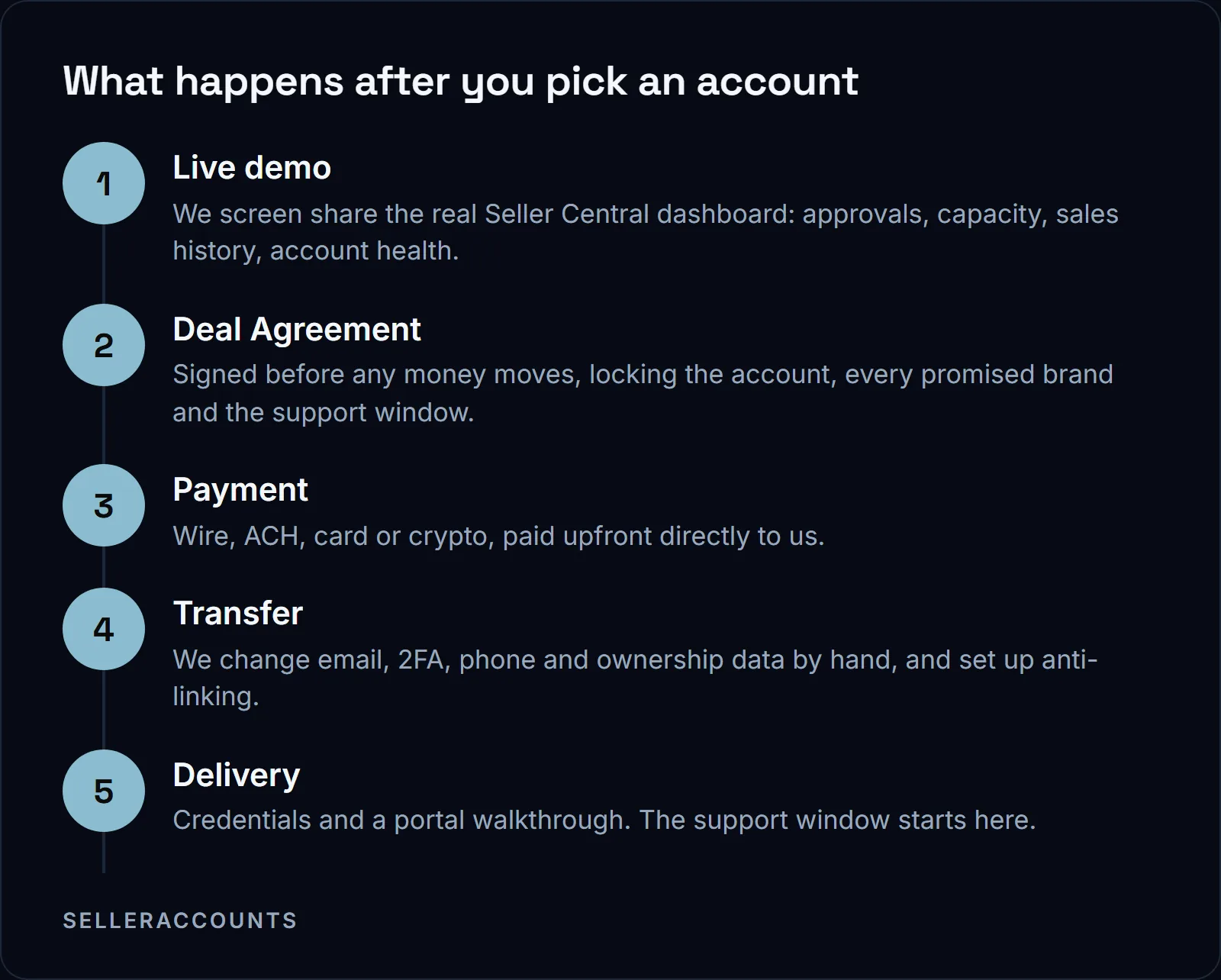
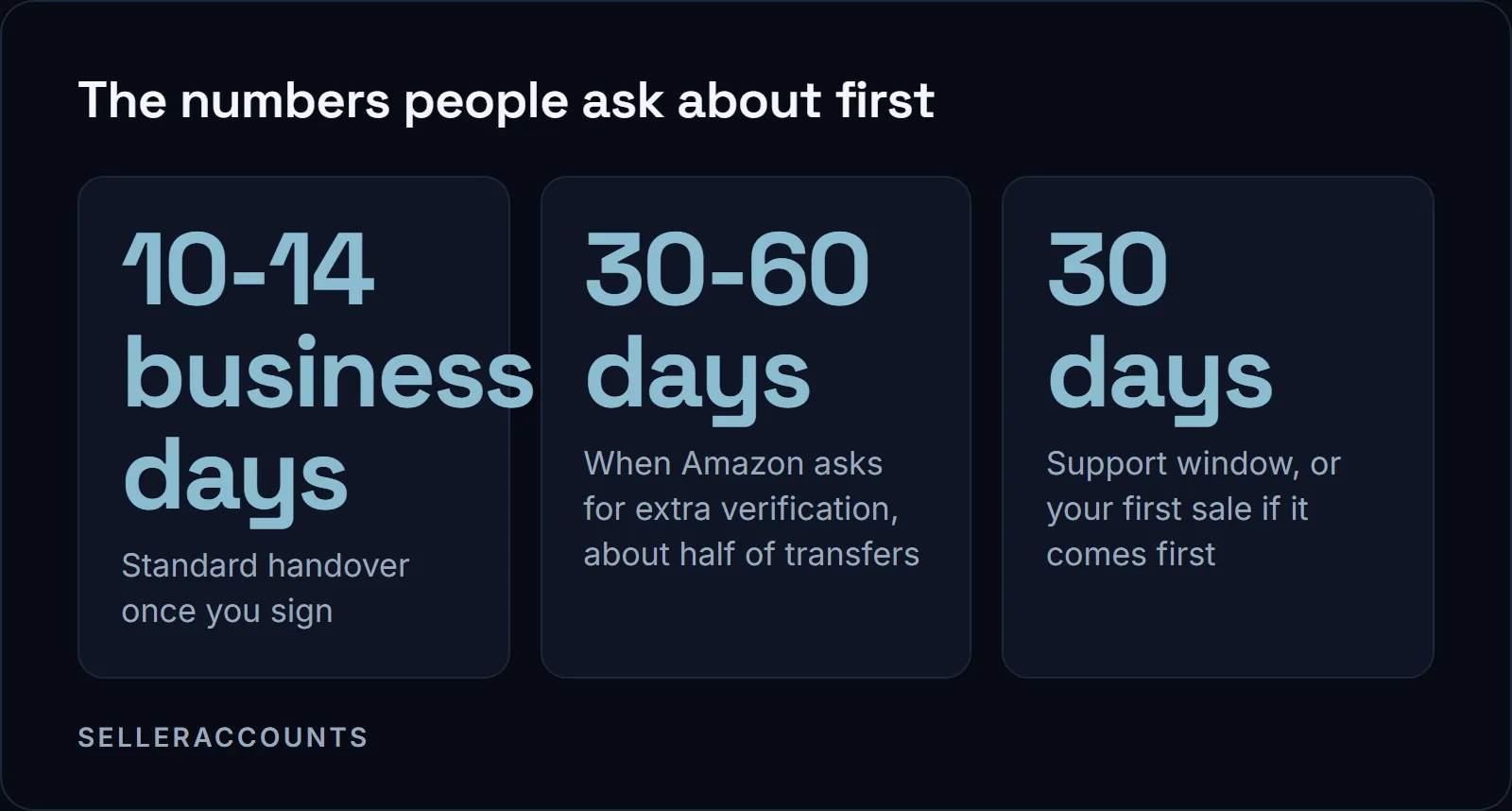
The account you see on the demo is the account we commit to deliver. About half of Amazon transfers draw an extra verification request from Amazon and run the longer 30 to 60 day path instead of the 10 to 14 business day standard one; neither path is promised in advance, and both get the same handling, a status update every business day. If a brand we promised is still gated at delivery, we keep working on it: a replacement account comes first, and a refund follows only if no suitable replacement is found by day 30. The full step-by-step, including what anti-linking means and why it matters, is in how an Amazon account transfer works.
What Happens After the Transfer?
Support runs 30 days from delivery or until your first sale, whichever comes first, and covers verification resubmissions, transfer-related suspensions and login help, not anything your own selling triggers. Email, phone, 2FA and the ownership data all change to you as part of the handover itself.
The account arrives with a temporary phone number, and it has to be replaced with your own clean one soon after delivery, one that has never touched Amazon before on either a buyer or seller account, or the new account risks getting flagged. Your delivery file carries the date it needs to be swapped by. Anti-linking setup is part of the same by-hand handover, done alongside changing email, 2FA and phone. Past the support window, the account is yours to run: our part is the transfer and the 30 days after it, not your ongoing selling.
FAQ
Does an aged Amazon account get paid faster than a new one?
No. Since March 12, 2026, every Amazon account, in general, settles every two weeks and holds each order until seven days after delivery, whether the account is brand new or years old.
What does an aged Amazon seller account cost?
We do not publish prices on this site. For real numbers on a specific account, start at how much an aged Amazon account costs or go straight to the aged Amazon accounts available now.
Is it legal to buy an Amazon seller account?
What we sell is not a workaround for Amazon's rule against transfers: it is a full handover under a signed Deal Agreement and upfront payment, done by hand so the account, email, 2FA and ownership data all move to you cleanly. Amazon's own help page says "Seller accounts generally are not transferable," and that a new owner must establish a new account if business ownership changes. We do not soften that.
How many brand approvals come with the account?
Three, apply to sell only, and every one is named in the deal agreement before you pay. Any other approval, hazmat, Seller Fulfilled Prime, Renewed or a specific brand, is account-specific and shown on that account's own record at the demo.
What are the risks of buying an aged Amazon account?
The real risk is a handover that skips the paperwork: no re-verification, no signed agreement, just a login passed along in a chat. Other risks are the account linking back to its previous owner if cleanup is skipped, a temporary phone number left in place past its expiration date, and a seller who will not screen-share the live account before you pay. Ask to see the account on Zoom first; a seller who will not show it is the clearest red flag.
Will the account be linked to me or to its previous owner?
Handover runs through an anti detect browser with a clean proxy, and the previous owner's cards, addresses and subscriptions come off the record before you get it. The temporary phone number we hand over at delivery has to be swapped for one that has never touched Amazon before, on either a buyer or seller account, which is what keeps the account from linking back.
Related pages
Ready to Scale Your Amazon Business?
Book a free demo call and we'll screen-share real accounts live to find the right match for your business. No screenshots, no guesswork.
Book Your Demo