
The Short Answer: the Account Stays, the Business Moves
No. You cannot sell your eBay account, hand the login to someone else, or ask eBay to put a new owner's name on it. eBay's own help page says the account cannot be sold and its ownership cannot change, and it names the penalty for trying.
What does change hands in a real deal is the business behind the account. The account keeps what it earned: its feedback, its selling limits, its trading history. The registered details behind it are replaced afterwards, one at a time. Replacing those fields is not the same act as asking eBay to name a new owner: one is the account's own details being brought up to date, the other is the thing eBay's page refuses. eBay publishes no route for that and no approval of it, so anyone telling you eBay blesses a change of owner is telling you something eBay never wrote down.
We sell aged Amazon, Walmart and eBay seller accounts, 1,700+ of them since 2020. eBay is newer work for us than Amazon, which is why this page quotes eBay rather than us.
What eBay Actually Says About Changing Ownership
Here is eBay, word for word.
The help page on selling an account is the blunt one:
"In the interest of protecting our buyers and sellers, and maintaining a safe marketplace, you can't sell your eBay account or change its ownership."
"Attempting to sell an eBay account may result in buying and selling restrictions as well as account suspension or removal."
The User Agreement, in its list of things you agree not to do, puts it slightly differently:
"transfer your eBay account (including feedback) and user ID to another party without our consent;"
"share your log in credentials with any third parties. If you require that authorized third parties (employees, agents, etc.) have access to your account we offer a Multi-User Account Access program for that purpose."
Read them together and the picture is consistent. Handing your log in credentials to a third party while the account stays yours is out, and eBay points that case at its own access program instead. Selling the account is out, and eBay names the consequence rather than hinting at it. The User Agreement's "without our consent" is the only door in either document, and eBay's help page on selling an account describes no way to ask.
Every eBay passage quoted on this page was checked word for word against eBay's User Agreement and help pages on 17 September 2026. This is general information about how marketplace deals are structured, not legal advice. If a specific deal matters to you, have a lawyer look at it.
How Do I Let Someone Else Run My eBay Account?
Use Team access, eBay's own program for letting other eBay users work on your account without your password. It is the route the User Agreement points at instead of sharing your log in credentials, and it changes nothing about who owns the account. A manager, an assistant or a business partner belongs there.
In eBay's words, "With Team access, you can grant access to your account to other eBay users by sending invites from the Team access page in My eBay." The User Agreement names the same program under its older name: eBay's help page describes Team access as "formerly Multi-user account access", so the Multi-User Account Access program in the agreement and Team access on the site are one thing.
Four Things People Mean by the Word Transfer
Most of the confusion comes from four different questions wearing one word.
| What you mean | What it actually is | Where eBay's text leaves it |
|---|---|---|
| Change the name on my own account | No new owner, so no change of ownership | The page above does not cover editing the registered name |
| Hand the account to a family member | A change of ownership | eBay's help page says ownership cannot change |
| Sell the account to a buyer | A change of ownership | The same page, the same answer, plus the restriction warning |
| Sell the company that holds the account | A business sale | The business changes hands. The registered details are replaced afterwards, and eBay publishes nothing that approves it |
Can You Move the Listings to Another Account Instead?
No. Listings do not move between eBay accounts. In practice you relist rather than transfer, and the feedback, the selling limits and the trading history stay with the account they were earned on, which is the whole reason the account is the asset. SixBit Software's knowledge base puts it in one line:
"No, eBay does not allow the direct transfer of listings from one seller account to another."
Selling limits are the monthly cap eBay puts on how much a seller can list and sell, raised as a seller gets comfortable meeting buyer demand. They stay with the account, not with you. More on that cap in eBay selling limits on aged accounts.
Buying a Login Versus Buying the Business Behind It
Grey market here means an anonymous listing with no company behind it and nothing signed.
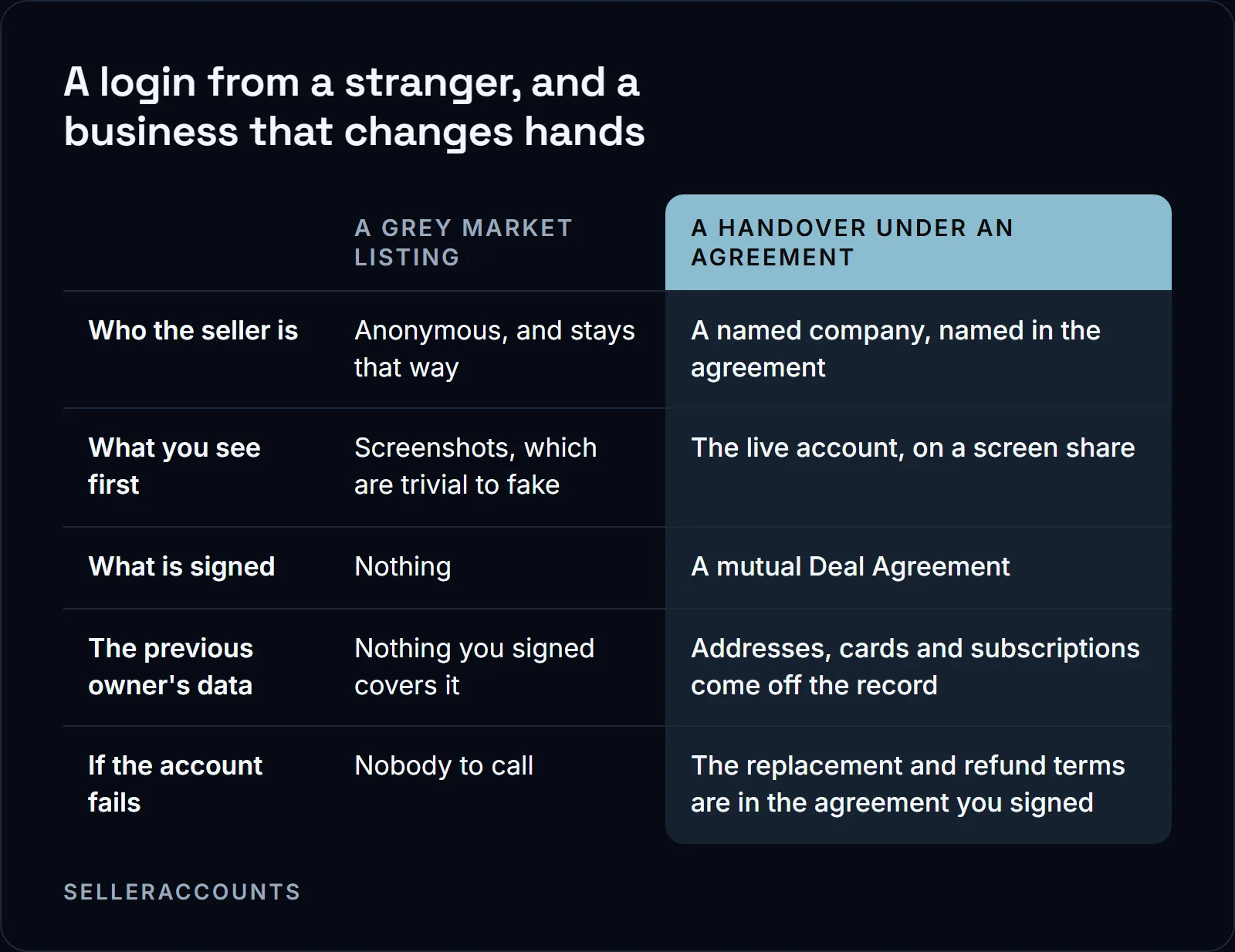
Our own terms sit in that right column. Payment is upfront to a named company, against a mutual Deal Agreement signed before any money moves: wire, ACH, card or crypto, with a card fee of 3% on US issued cards and 4.5% outside the US. We do not publish prices. Ask about a specific account and the price comes with its details, on the aged eBay accounts page.
Reading this from the other side, with an eBay account you want out of? That is our sister brand's lane: Cash For Stores (cashforstores.com) buys the business behind an eBay account from its owner. Everything on this site is for buyers.
What Actually Has to Change, and What Gets a Payout Held
A handover moves far more than a login.
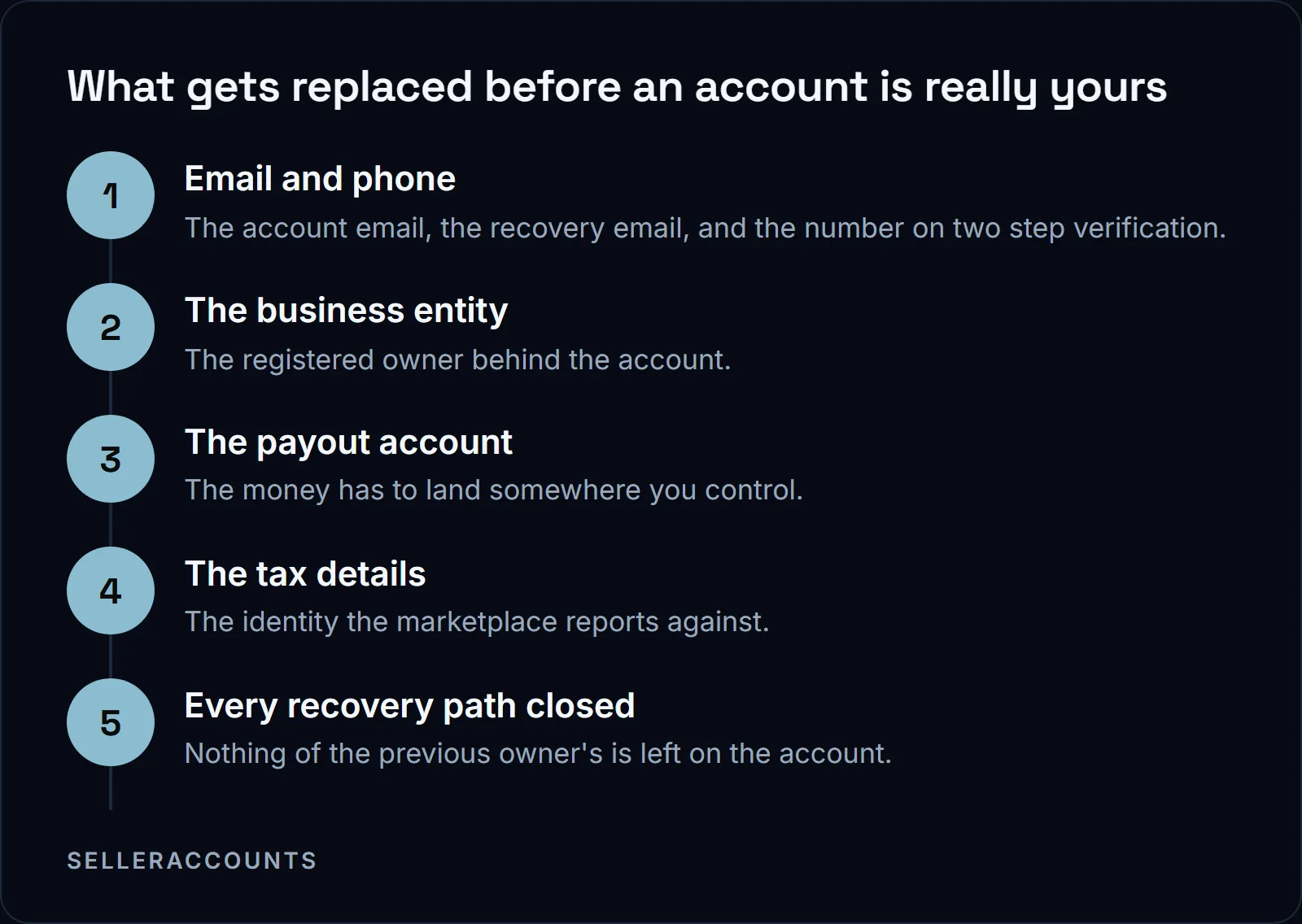
None of this is only a platform matter. Under the INFORM Consumers Act, an online marketplace has to collect and verify a high-volume third party seller's bank account number or payee name, contact information, tax identification number, and a working email address and phone number. The Act sets that bar at 200 or more discrete sales of new or unused consumer products and $5,000 or more in gross revenues in any continuous 12-month period during the previous 24 months. For your own handover that is the paperwork, and it is why the weeks go on verification rather than on a password change. The transfer form we send you asks for your entity details, a photo ID and a bank statement.
Two mistakes to avoid:
- Everything at once. eBay's help page on getting paid names registration discrepancies and an unvalidated Form W-9 among the reasons a payout is held at account level, alongside unusual activity. Pushing the entity, the payout account and the contact details through in the same hour puts all of that in front of eBay at once.
- Trading hard immediately. eBay says payouts may be held when it identifies "unusual activity associated with your account, such as increased customer claims, a sudden change in your selling activity, late deliveries, or negative buyer feedback".
How Long Does an eBay Account Handover Take?
2 to 3 weeks is our standard eBay handover, and 3 to 5 weeks is the realistic window. The handover is the work of moving the business and replacing the account's registered details one at a time, not eBay renaming an owner. Those weeks are written into the agreement before you pay.
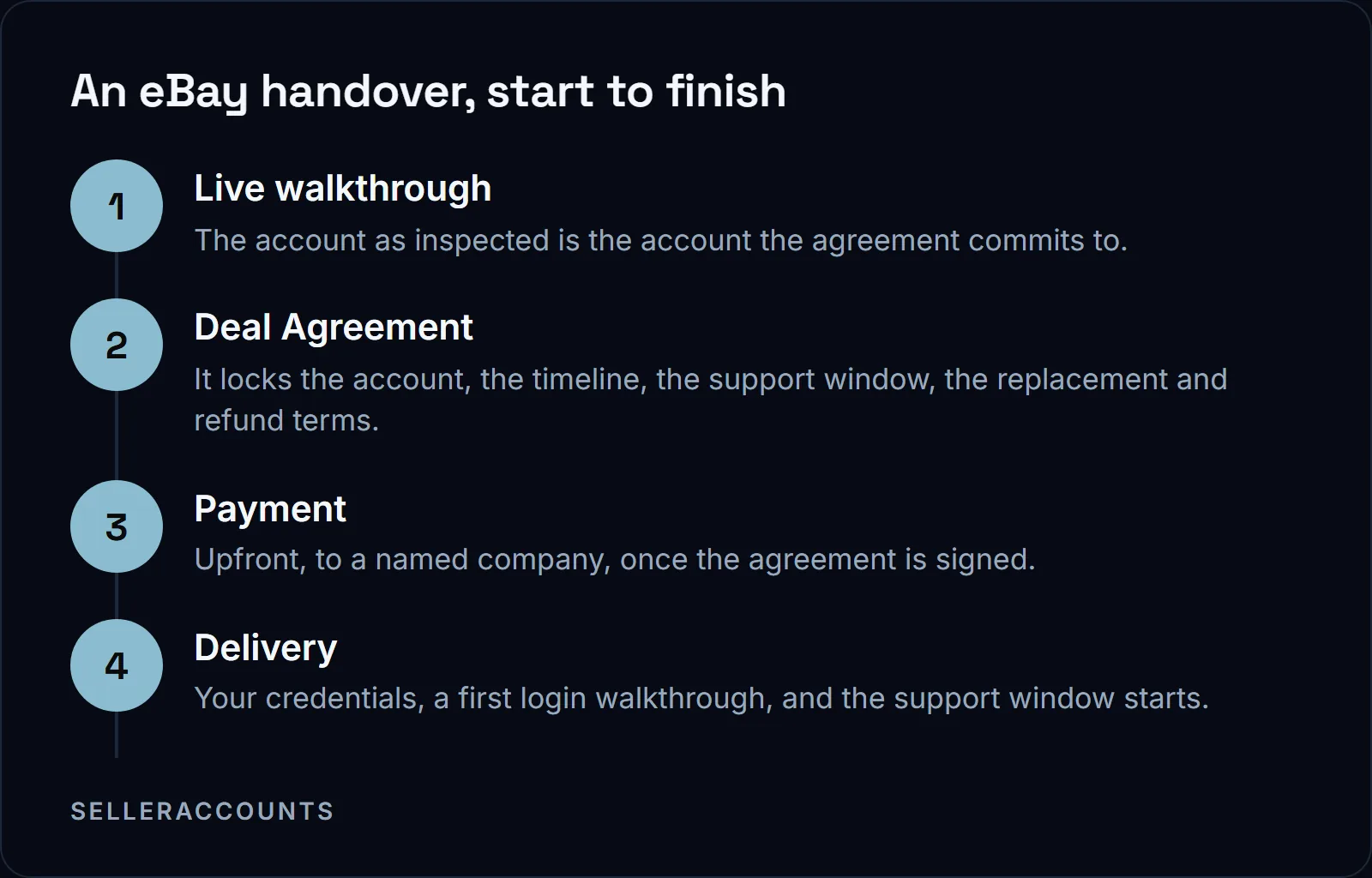
The handover is done by hand rather than by a script, and we deal with the marketplace correspondence on your behalf.
Support then runs 30 days from delivery or until your first sale, whichever comes first. If your first sale lands on day three, support ends on day three. It covers verification re-submissions, transfer related suspensions and login help, not anything your own selling triggers.
The remedy is in the agreement too, and it is the clause worth reading in any deal, ours included. The Deal Agreement locks the replacement and refund terms. In the Asset Purchase Agreement, which goes out when a buyer asks for one, that reads as a replacement first, with a full refund if no suitable replacement is found within thirty days.
What eBay's Payout Rules Mean for an Account You Buy
An aged eBay account does not pay faster because it is old. eBay's default is daily payouts: "By default, payouts are initiated daily, but you can also change to weekly, biweekly or monthly payouts." With no hold on it, eBay's own wording puts a seller roughly three to five days from sale to cash, typically 1 to 2 days for proceeds to become available, then typically another 1 to 3 business days to clear in the bank.
The holds are the part that matters when you are buying. eBay holds funds until delivery is confirmed for new sellers, for accounts with no recent selling history, for the 30 days after a restriction or suspension is lifted, and when it sees unusual activity.
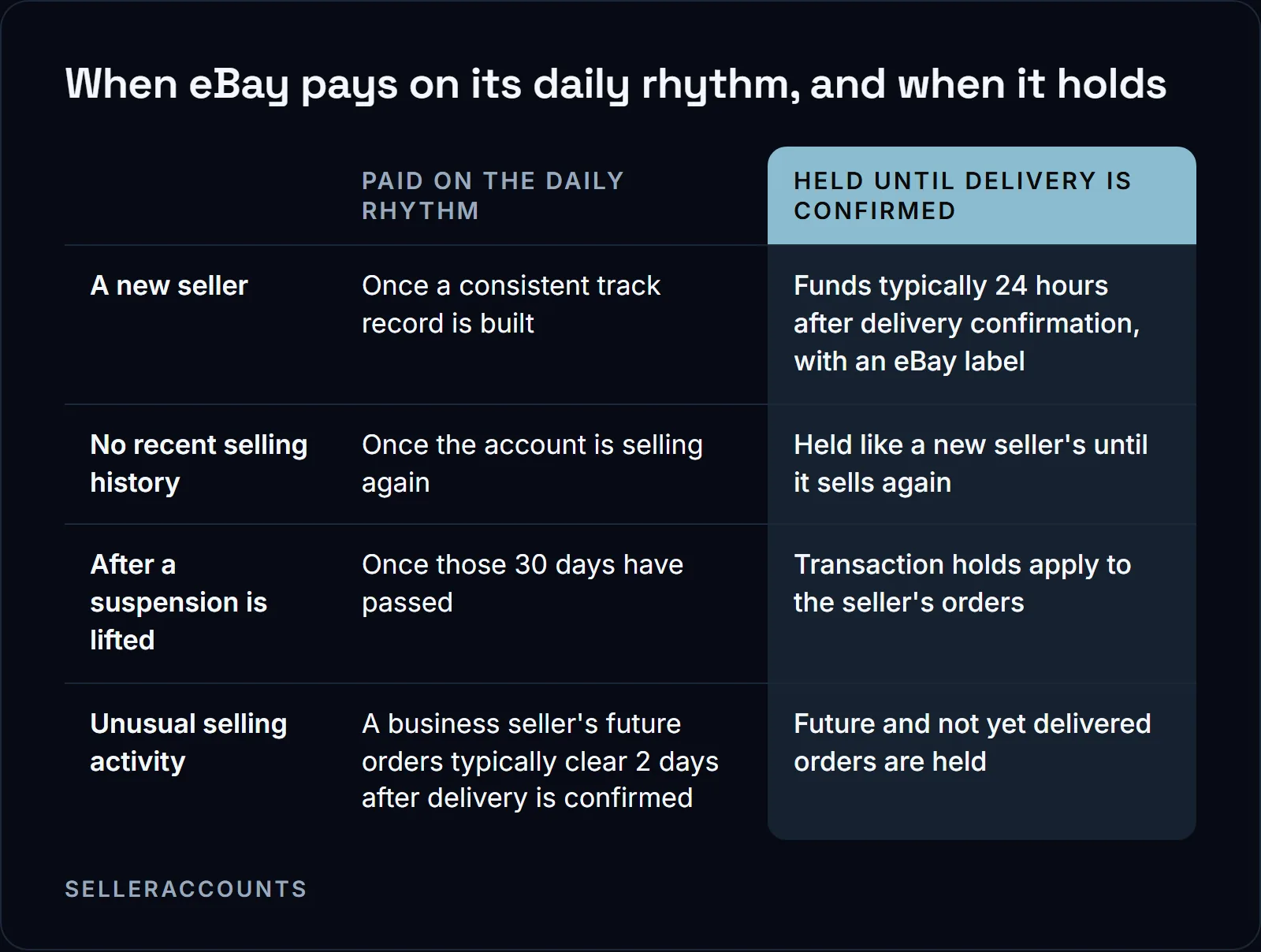
"Sellers who haven't yet established a strong, consistent track record or who don't have any recent selling history will typically receive their funds 24 hours after delivery confirmation (for tracked items), or 31 days after the buyer pays (for items sent without tracking)."
eBay adds: "If you previously qualified to receive your funds faster as a new seller, you may experience this hold if you haven't sold in a while."
So an account sitting idle is treated much like a new seller's until it sells again. The account worth buying is the one selling now and selling cleanly, which is what a live walkthrough is for, and the same logic runs through aged eBay account vs new account.
FAQ
Can I transfer my eBay account to someone else?
No, not the account itself. What can change hands is the business that holds the account, which is a different transaction with different paperwork. If all you want is someone else working in the account, Team access does that without any change of owner.
Can I transfer my eBay account to a family member?
Not as a handover of the login, and not by asking eBay to write a new name on the account. The help page covers that: ownership cannot change. If the account belongs to a business and the business passes to a family member, that is a business changing hands, and the registered details behind the account are replaced afterwards. If you only want a relative to help run it, Team access is the route eBay publishes.
Is it legal to sell or give away an eBay account?
This is a contract question with eBay before it is anything else. eBay's User Agreement and help page govern the contract between you and eBay, and breaking it has contractual consequences: restrictions, suspension or removal. Legal and allowed by eBay are two different tests and they get confused constantly. We are not lawyers, so take a specific deal to one.
Can I change the name on my eBay account?
Two different things get called that. If you still own the account and you are editing the registered name, no new owner is involved, so the rule against changing ownership is not what stands in your way; eBay's help pages on changing account settings carry its own instructions, and we will not describe steps eBay has not published. If the account is moving to a different owner or a different entity, that is the business sale described above, and Selling an account and changing ownership is the page that speaks to it.
Related pages
Ready to Scale Your Amazon Business?
Book a free demo call and we'll screen-share real accounts live to find the right match for your business. No screenshots, no guesswork.
Book Your Demo