
The Short Answer
Amazon stores for sale are one of three things: an aged seller account, an aged store (account plus listings and stock), or a whole Amazon business. Buy the business if you want its income; buy the aged account if you want access and will bring your own products.
Three terms, one sentence each:
- An aged seller account is a Seller Central account with years of selling history, feedback and approvals, sold without stock; it is what we sell.
- An aged Amazon store is an aged seller account plus its listings and stock.
- An established Amazon business is the whole operation: the brand, its listings, its stock, its suppliers and the account it sells on.
The route that skips buying is a new account you open yourself and grow slowly. Whichever route you weigh, read the first line of Amazon's Can I transfer my seller account? page: "Seller accounts generally are not transferable."
We sell aged accounts, 1,700+ since 2020, so read this knowing which side of the table we sit on. Everything about Amazon's rules comes from Amazon's own pages, linked where we use them.
What Does "Amazon Stores for Sale" Actually Mean?
Amazon FBA stores for sale can mean the account alone, the account with its listings and stock, or the whole business with its brand and suppliers. Ask every seller one question before anything else: what exactly moves to me, the account, the stock, or the brand and its suppliers?
Two more terms:
- FBA and FBM are the two fulfillment methods Amazon's selling FAQ offers for each product: Fulfillment by Amazon and Fulfilled by Merchant.
- Gated means Amazon requires approval before an account can list a brand or category. Ungated means the account already has that approval.
Whole Business, Aged Account or New Account, Side by Side
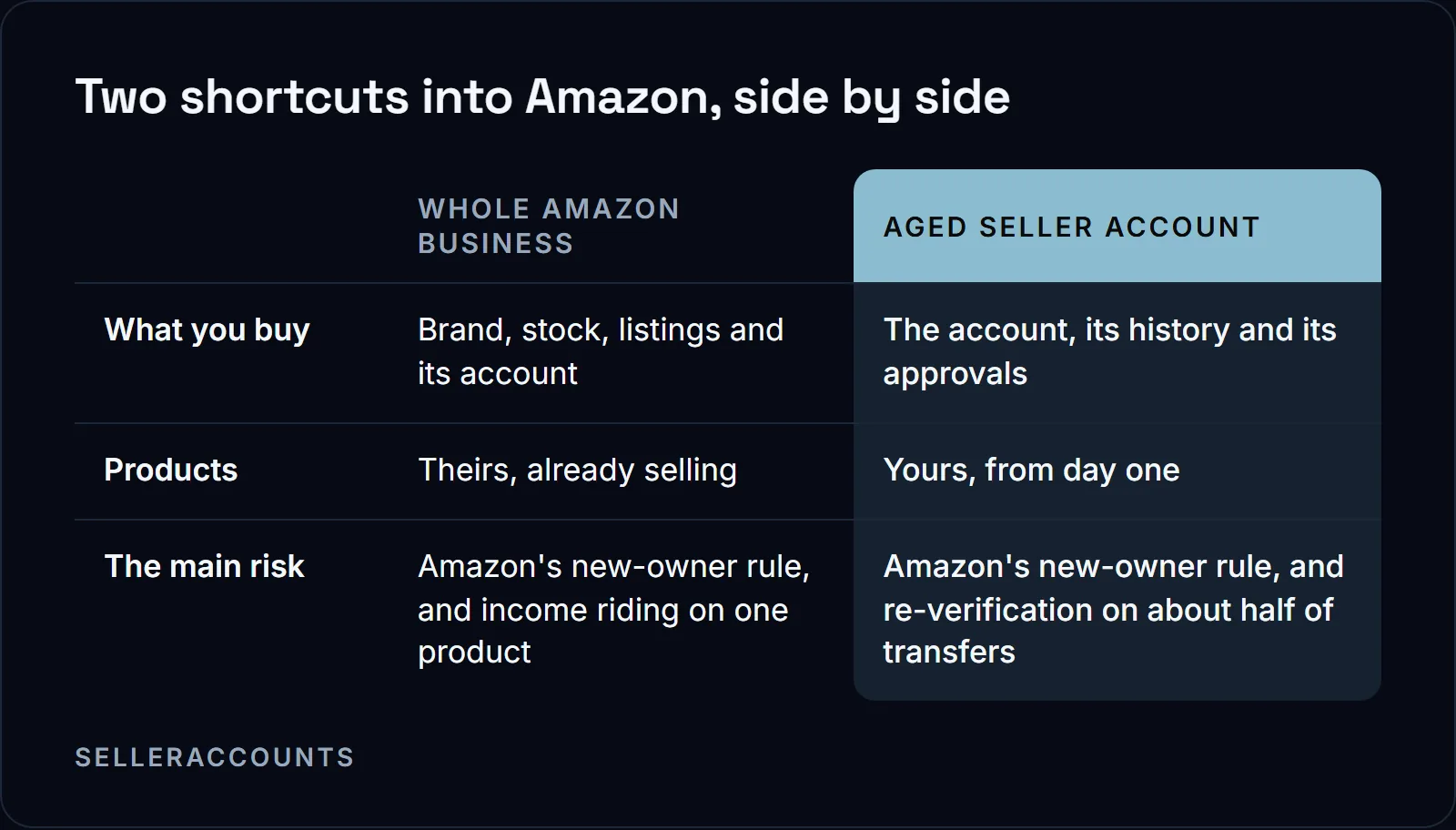
The fuller version, with a new account added:
| New account | Aged seller account | Whole Amazon FBA business | |
|---|---|---|---|
| What you get | An empty account in your name | An account with years of history, feedback and approvals | A running brand with its listings, stock, suppliers and account |
| Brand and category approvals | You apply one by one. Amazon's review is 2 to 7 business days per application, and we plan on a month per brand | Already ungated, often for dozens of brands, shown live, plus three brand approvals we open on request, named in your Deal Agreement | Whatever the business needed for its own products |
| Seller Fulfilled Prime, Hazmat, Renewed | Qualify from zero | Only where that account's record carries them | Only where its account holds them |
| Inventory and listings | None | Not included | Part of the deal, if the contract lists them |
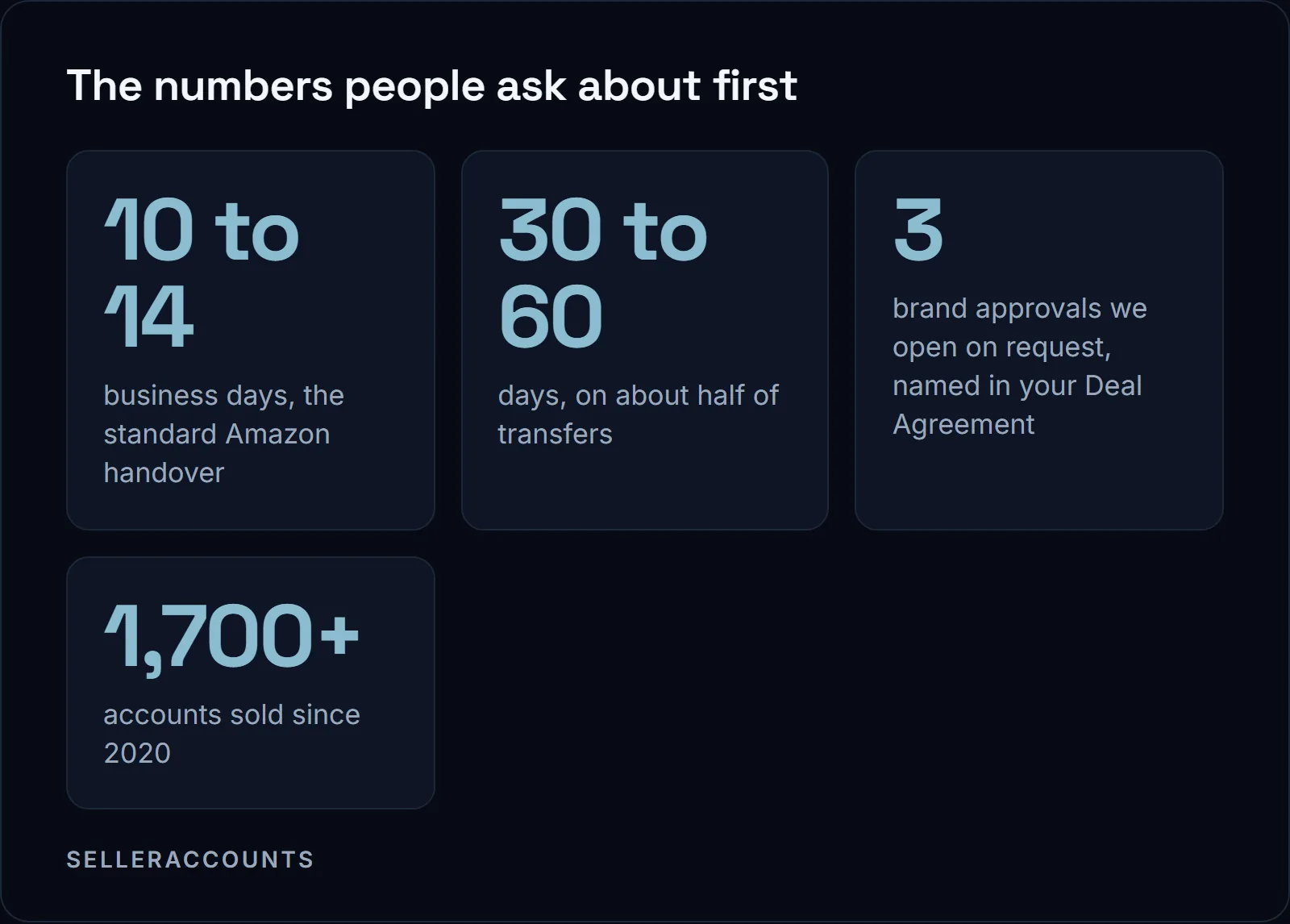
| Time until you can sell | Registration, then each approval applied for one by one | 10 to 14 business days standard; about half run 30 to 60 days | Set by the deal and the handover |
| Amazon's ownership rule | Opened in your own name | The new owner must establish a new seller account | The new owner must establish a new seller account |
| Main risk | Approvals applied for one by one | Amazon's new-owner rule; extra verification on about half of transfers | Amazon's new-owner rule; income that rides on one product |
| Best for | Patient sellers testing an idea | Sellers with products or sourcing who need access now | Buyers who want income more than access |
A new account needs a valid credit card, bank account, phone number and tax information, and Amazon may ask for scans of a passport, national ID or statements. That list is on Amazon's registration requirements page. What the account does not hold is any approval, and Amazon ties each one to documents, invoices, metrics over a set window or a waitlist.
Can You Buy an Amazon Business and Keep Its Seller Account?
No. Amazon's help pages say that when business ownership changes, the new owner must establish a new seller account, and that you can't transfer the account. Amazon's rule does not change when an account or a business is sold, and the buyer carries that risk.
Amazon's Can I transfer my seller account? page puts it plainly:
"If the ownership of a business changes for any reason, the new owner must establish a new seller account."
That sentence covers a whole FBA business and an aged account alike. A seller who skips this is leaving out Amazon's own rule on a change of owner.
Amazon's page offers no way to keep an account through a sale, and what we run is not an exception Amazon grants. It is a documented change of business ownership, done by hand. The previous owner's company, ID, card and bank details come off the record, yours go on, and every verification is redone in your name: government ID, business address, bank account, email, phone, tax ID and the business point of contact. The INFORM Consumers Act is one reason those checks exist. It requires a marketplace to collect and verify a high-volume seller's bank, contact and tax details.
Brand Registry is a separate question. Amazon's Brand Registry page says "You must be the trademark owner." In a business purchase, check whose name the trademark is registered in, and have your lawyer confirm how it moves to you.
What Does an Aged Account Already Hold That a New One Waits For?
Approvals. A new account applies for each brand and category, and each hard program asks for invoices, a performance record or a waitlist. An aged account may already hold some of these. Which ones a given account holds is on its record; you see it before you buy.
Here is what Amazon asks for each of the hard ones:
- Brand and category approval. Purchase invoices dated within 180 days, clear photos showing all sides, brand authorization letters if applicable, and safety certifications when required. Then 2 to 7 business days of review. Some products need more than one approval: Amazon's own example is Nike shoes, which need Shoes category approval and Nike brand approval. If the answer is "Your account does not qualify", Amazon's approval page says the decision cannot be appealed.
- Seller Fulfilled Prime. The program whose Prime shipping template lets a seller configure Prime offers. It needs a Professional account, and over the past 90 days at least 100 seller-fulfilled packages, a cancellation rate under 2.5%, valid tracking above 95% and late shipment under 4%. Then the trial: "Second, you must pass the trial by participating for 4 weeks while meeting all of the trial requirements." Three attempts per calendar year at most.
- Hazmat. Amazon's hazmat page describes a waitlist, with an email when a chance to participate opens, and capacity limits based on store performance and the space you actively use. Typical enrollment is five business days, and "At this time, there is no way to expedite enrollment into the program."
- Amazon Renewed. Invoices that meet a minimum purchase value, an order defect rate of 0.8% or less over the trailing 60 days, and a review Amazon's Renewed page aims to finish within 10 days.
Building sales history, FBA capacity and distributor trust from zero takes 12 to 24 months, by our count. An aged account skips the wait for whatever it already holds. On top of that, every account we sell comes with three brand approvals, each named in the Deal Agreement. Apply to sell only means these are brands we apply for and open on your request, on top of the approvals the account already holds.
What age does not buy: payout speed. In general, Amazon settles every two weeks, and since March 2026 every account holds each order's money until seven days after delivery (DD+7). Amazon can extend that on risk and never shortens it for age.
What Should You Check Before Buying Any Amazon Store?
See the live Seller Central dashboard on a screen share, never screenshots. Check account health, sales history and which brands are open. For a whole business, also check whose name the trademark is in, how much revenue rides on one product, and what the contract lists. Then have an accountant read the books.
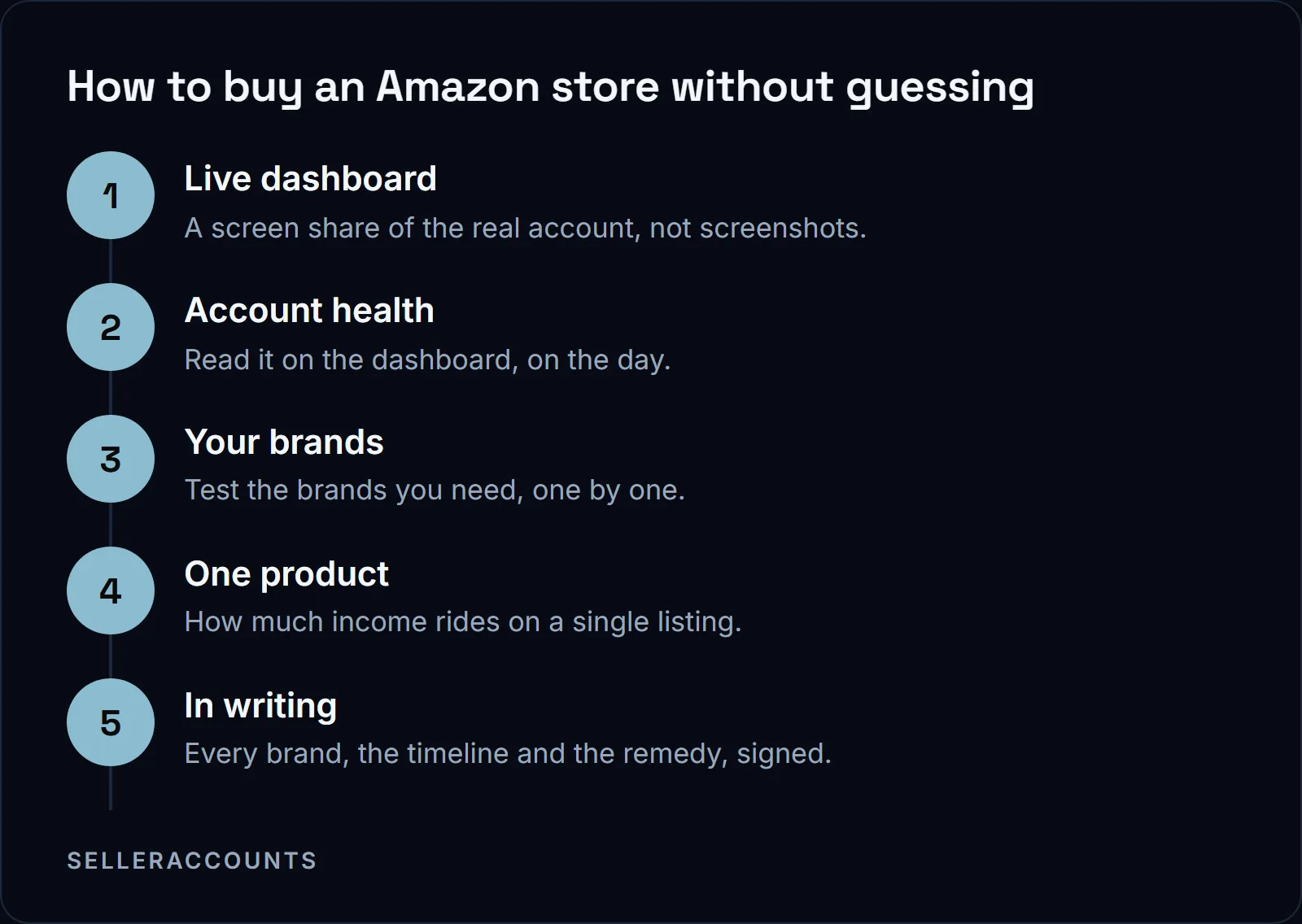
Whole Amazon FBA businesses are listed on broker marketplaces and bought through a broker deal. Most listings show numbers you can't verify. A seller's claimed numbers are a claim until you see them inside the account itself. When buying an existing Amazon FBA business, check that the inventory count is real, which supplier contracts move to you and which stay with the seller, and whether the brand depends on one listing. A business that leans on one product carries that product's risk.
Gating also moves. Amazon's approval FAQ warns: "Even if you were selling your product before, you may be subject to new restrictions". An approval held today is worth checking today, not last month.
For an aged account, send the seller the brands or product codes you need before you sign. We check every list against the real account and come back with a result for each brand.
Which Shortcut Fits You
| If you want | Take this route |
|---|---|
| A brand with its products, listings and suppliers already in place | A whole Amazon FBA business |
| Access to brands and programs for products you already source | An aged seller account |
| A cheap test with a product that needs no gated brand | A new account |
| A second account, with a legitimate business need and every account in good standing, as Amazon's code of conduct requires | An aged seller account |
An aged account is for wholesale and arbitrage sellers who need brands open, private label sellers who want history behind their launch, and established sellers who want a second account.
If you are on the other side and want to sell your account, that is our sister brand, Cash For Stores.
Who Should Not Buy an Aged Account?
Anyone who wants income without selling. Seller Accounts sells accounts, not revenue-bearing businesses. You get history and approvals, not products, customers or sales. If you want a business that already earns, look at an established Amazon business. If you have no products yet and need no gated brand, open a new account and start slowly.
This is not for you if:
- You cannot wait out a handover that runs 30 to 60 days on about half of transfers.
- You will not pass verification in your own name. Every check is redone with your documents: ID, address, bank, email, phone and tax ID.
- You want a UK or EU account. We close those marketplaces on the accounts we sell.
How Buying an Aged Account From Us Works
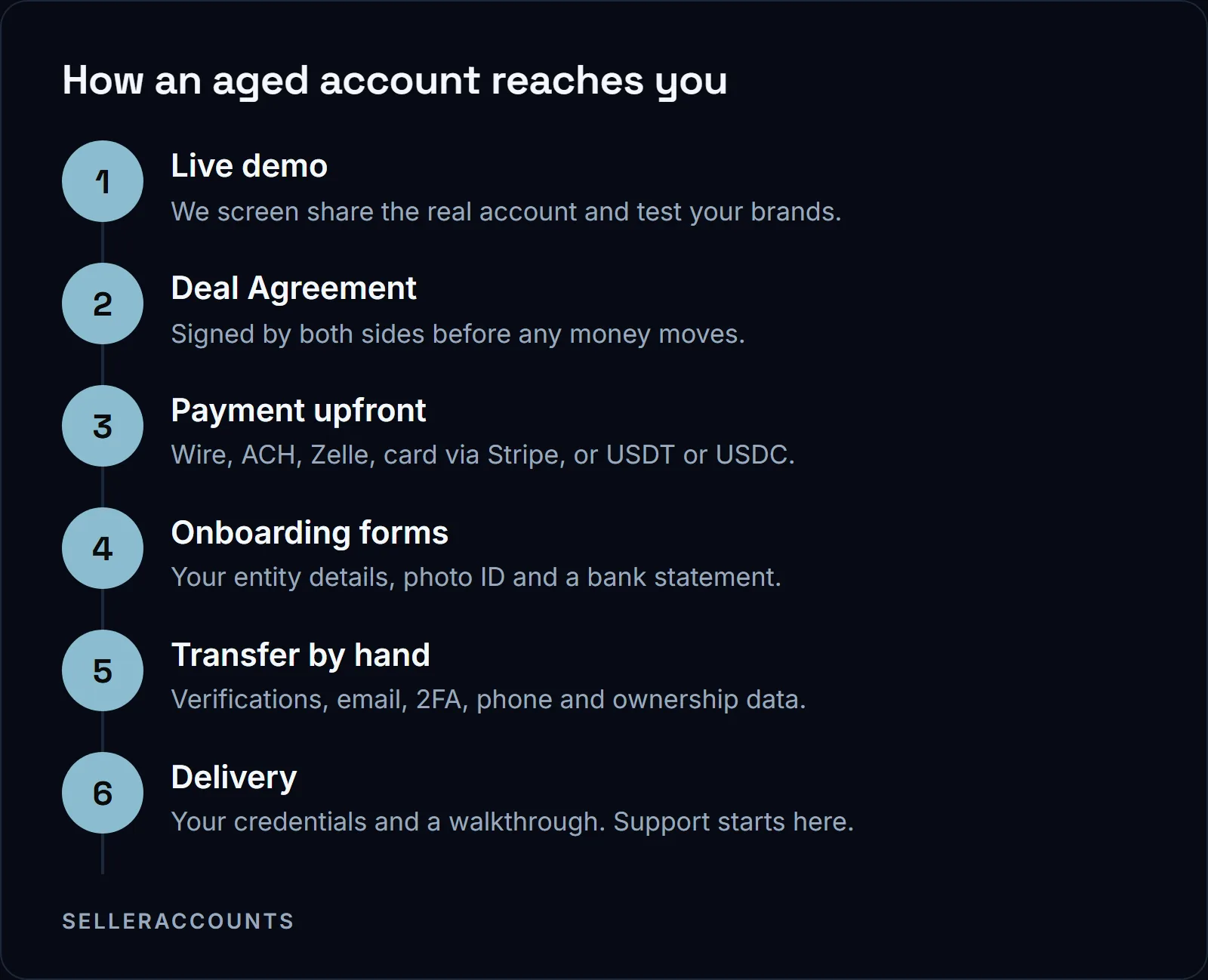
Payment goes upfront to the company named in the Deal Agreement. Card carries 3 percent on US-issued cards and 4.5 percent on non-US cards; wire, ACH, Zelle and crypto in USDT or USDC carry no fee. The account as inspected on the demo is what we commit to deliver.
During the transfer we handle every Amazon interaction and send a status update every business day. Support runs until 30 days after delivery or your first sale, whichever comes first. If a brand we promised is still gated at delivery, we keep working on it, and if it is not open by day 30 the remedy is a replacement account, then a refund.
Starting prices are on our price page. The exact figure for a given account comes with that account's details, on the call, because age, history and approvals differ from one account to the next.
Ready to see a real account? Start with our aged Amazon seller accounts, or read how buying works step by step.
FAQ
Can you buy an Amazon business?
Yes: whole Amazon FBA businesses are sold through brokers and marketplaces, and aged accounts through sellers like us. We sell accounts, not businesses. Amazon's help page says the new owner must establish a new seller account when business ownership changes, so read that page before you pay for any Amazon store or business.
Do aged Amazon stores for sale come with inventory?
An aged Amazon store includes its listings and stock. An aged account, which is what we sell, does not. You get the account, its history, its feedback and its approvals.
How long until I can sell on a bought account?
Plan on 10 to 14 business days. About half of transfers get an extra verification request from Amazon, and those run 30 to 60 days.
Does an aged account get paid faster on Amazon?
No. Since March 2026 every Amazon account holds each order until seven days after delivery, and age does not shorten that.
Related pages
Ready to Grow Your Amazon Business?
Book a free demo call and we'll screen-share real accounts live to find the right match for your business. No screenshots, no guesswork.
Book Your Demo