

The Short Answer
Amazon settles every two weeks and holds each order until seven days after delivery; Walmart pays every two weeks on a fixed cycle; eBay pays out daily by default but holds new and idle sellers until delivery is confirmed. We have sold 1,700+ aged Amazon, Walmart and eBay accounts, and on a Walmart transfer the payout account we connect is your own, in your company's name.
The schedule is set by the marketplace, not by the age of the account.
Walmart vs Amazon vs eBay, Side by Side
A payout schedule is the rhythm on which a marketplace sends your sales money to your bank or payout account. A reserve is money the marketplace keeps back from that payout to cover refunds, claims and chargebacks.
7 days
Amazon holds each order after delivery (DD+7)
14 days
Walmart's usual payout cycle
1 to 2 days
eBay, typically, from buyer payment to funds available, with no hold
| Amazon | Walmart | eBay | |
|---|---|---|---|
| Cycle | Settles every two weeks, in general | Biweekly, every 14 days, alternate Fridays | Daily by default; weekly, biweekly or monthly if you choose |
| What starts the clock | Delivery date, then seven more days | Shipment, inside a 14-day period | Buyer payment, or delivery on held accounts |
| Order hold | DD+7 on every account since March 2026 | Orders can be held seven or more days after shipping | Holds for new, idle, recently suspended or flagged sellers |
| Account-level reserve | Called normal on Amazon's own help page | Called normal on Walmart's own page | Allowed by eBay's terms; no standard rate published |
| New-seller rule | All funds can be held at first | Rolling delay up to 14 days until 90 days and a payment total are reached | Held until delivery confirmation while you build a track record |
| Faster option | Express Payout if eligible, Disburse on Demand | Marketplace Wallet shows funds within minutes of disbursement | Daily is already the default |
How Often Does Amazon Pay Sellers in 2026?
Amazon settles seller accounts every two weeks, in general, and each order's money stays reserved until seven days after delivery, a rule Amazon calls DD+7. Since March 2026 that applies to every account, old or new. Amazon can extend the reserve on risk, and account age is not on its list of things that shorten it.
DD+7 means delivery date plus seven days. Amazon's payments guide puts the cycle this way:
"In general, Amazon settles seller accounts every two weeks."
On each settlement, Amazon takes the beginning balance, adds sales, subtracts expenses, adjusts for refunds and withholds an amount in reserve. That reserved amount becomes the next period's beginning balance. The same guide gives the reason for the hold:
"With deliveries, we typically reserve funds for seven days to give customers time to inspect their purchases and get refunds if needed."
When an integrated carrier is used, Amazon takes the actual delivery date. Without valid tracking, it uses the latest estimated delivery date. Amazon's delivery date reserve page also says:
"Your reserve period may be extended following an assessment of your overall risk and historical performance."
In March 2026 Amazon moved the accounts that were not yet on DD+7 onto it. Nothing on Amazon's pages exempts older accounts. Payout speed is never a reason to buy an aged Amazon account from us.
What still moves money faster on Amazon:
- Express Payout. Amazon's When will I be paid? page says to "See if you are eligible for Express payout to receive transfers within twenty-four hours."
- Disburse on Demand. Amazon staff describe it as free, once every 24 hours, for funds already released.
- Clean performance. The same page lists keeping high performance standards under how to get paid faster.
Express Payout and Disburse on Demand speed up money that is already released. Neither shortens the seven days after delivery. Once Amazon sends a payment, it can take up to five business days to reach your bank.
How Often Does Walmart Pay Marketplace Sellers?
Walmart pays marketplace sellers every two weeks. Its own guide says payout generally occurs biweekly, every 14 days, and settlement cycles close on alternate Fridays at midnight Pacific time. Walmart can hold orders seven or more days after shipping, and it calls an account-level reserve a normal part of selling there.
From Walmart's Marketplace Learn guide on payout processing:
"Generally, payout occurs biweekly (every 14 days) unless alternate arrangements are made."
Your exact cut-off sits under Payment Information on the Statements page in Seller Center. Any shipment notice received after the cut-off is settled in the following cycle. Walmart's Retailer Agreement says it remits for products shipped in each 14-day period within 7 days of the end of that period. So on Walmart, shipping starts the clock. On Amazon, delivery does.
On reserves, Walmart's page is plain:
"It is a normal part of selling on Walmart Marketplace to see an account-level reserve in your statement summary."
Walmart publishes no reserve percentage, cap or duration. High return or chargeback rates can lead to delays or suspended payments.
The new-seller hold. Walmart calls it a rolling delay: each payment is held back for a set time. In the United States it is up to 14 days. It ends once 90 days have passed since your first order shipped and you have received a payment total Walmart sets. Walmart's page also says you could be paid as soon as 30 days after your first sale.
Where the money lands. Walmart does not pay by ACH direct deposit. You get paid through the Walmart Marketplace Wallet or an approved provider such as PayPal or Payoneer. In the Wallet, proceeds show within minutes of Walmart's disbursement, and a transfer to your linked account then takes 1 to 5 business days. Every method runs on the same settlement cycle.
What we see ourselves: an established Walmart account is paid its whole settlement every two weeks. That is our experience with the accounts we have handled, not a Walmart rule, and Walmart's page still allows a reserve on any account.
When Does eBay Hold a New Seller's Payouts?
eBay holds a new seller's funds until delivery is confirmed while they build a track record. It does the same for accounts with no recent selling history, for 30 days after a suspension is lifted, and when it sees unusual activity. Without a hold, eBay pays out daily by default, and funds typically become available one to two days after the buyer pays.
eBay's Getting paid page says:
"By default, payouts are initiated daily, but you can also change to weekly, biweekly or monthly payouts."
A transaction hold is eBay keeping one order's money, or all of a seller's orders, until a condition is met. New business sellers typically get funds 24 hours after delivery confirmation on an eBay label, or 15 days after the buyer pays with other shipping. After the payout is sent, it typically takes another 1 to 3 business days to clear at your bank.
The line that matters for an older eBay account sits on eBay's Transaction holds page:
"If you previously qualified to receive your funds faster as a new seller, you may experience this hold if you haven't sold in a while."
An eBay account that has sat idle is held like a new one until it sells again. Established sellers are not exempt either: a sudden jump in orders, more claims or late deliveries can trigger a hold. eBay's terms allow reserves but publish no standard rate.
Which Marketplace Pays Sellers Fastest?
With no hold in place, eBay usually moves money fastest, because it pays out daily by default. Amazon and Walmart both run on two-week cycles. The catch is that eBay's speed depends on recent, clean selling: a new, idle or flagged eBay account waits for delivery confirmation, so the fastest marketplace on paper is not always fastest for you.
How the three line up for one order, from Amazon's, Walmart's and eBay's own pages:
| Step | Amazon | Walmart | eBay, no hold |
|---|---|---|---|
| Money becomes payable | Seven days after delivery | At the close of the 14-day period it shipped in | Typically 1 to 2 days after the buyer pays |
| Sent to you | Next settlement, every two weeks | Within 7 days of that period's end | Typically within 2 days of payment |
| Reaches your bank | Up to five business days | 1 to 5 business days from the Wallet | Typically 1 to 3 business days |
None of the three pages gives a full day-by-day calendar for a specific seller. Your own Seller Central, Seller Center or Seller Hub shows the real dates.
Does an Aged Account Change When You Get Paid?
No. Amazon, Walmart and eBay each apply their own rules to every account. What changes is history: an aged Amazon account can already hold approvals a new one waits years for, an aged Walmart account is already approved, and an eBay account that is selling now avoids the idle-account hold.
On Amazon, the benefit is approvals, not payouts. An aged account's record can carry Hazmat, Seller Fulfilled Prime, Amazon Renewed or gated brands, and we name an approval only where that account's record shows it. More on that in our aged versus new Amazon account comparison.
On Walmart, the account is already approved to sell. Walmart publishes no rule on whether the new-seller hold applies again after an ownership change, and we have not seen it restart. We make no promise either way. Our guide to a Walmart seller account for sale covers what to check before you pay.
On eBay, buy an account that is selling now. Age alone does not buy faster payouts, as our aged versus new eBay account guide explains.
How the payout account moves on a Walmart transfer. Here is how the payout account moves to you:
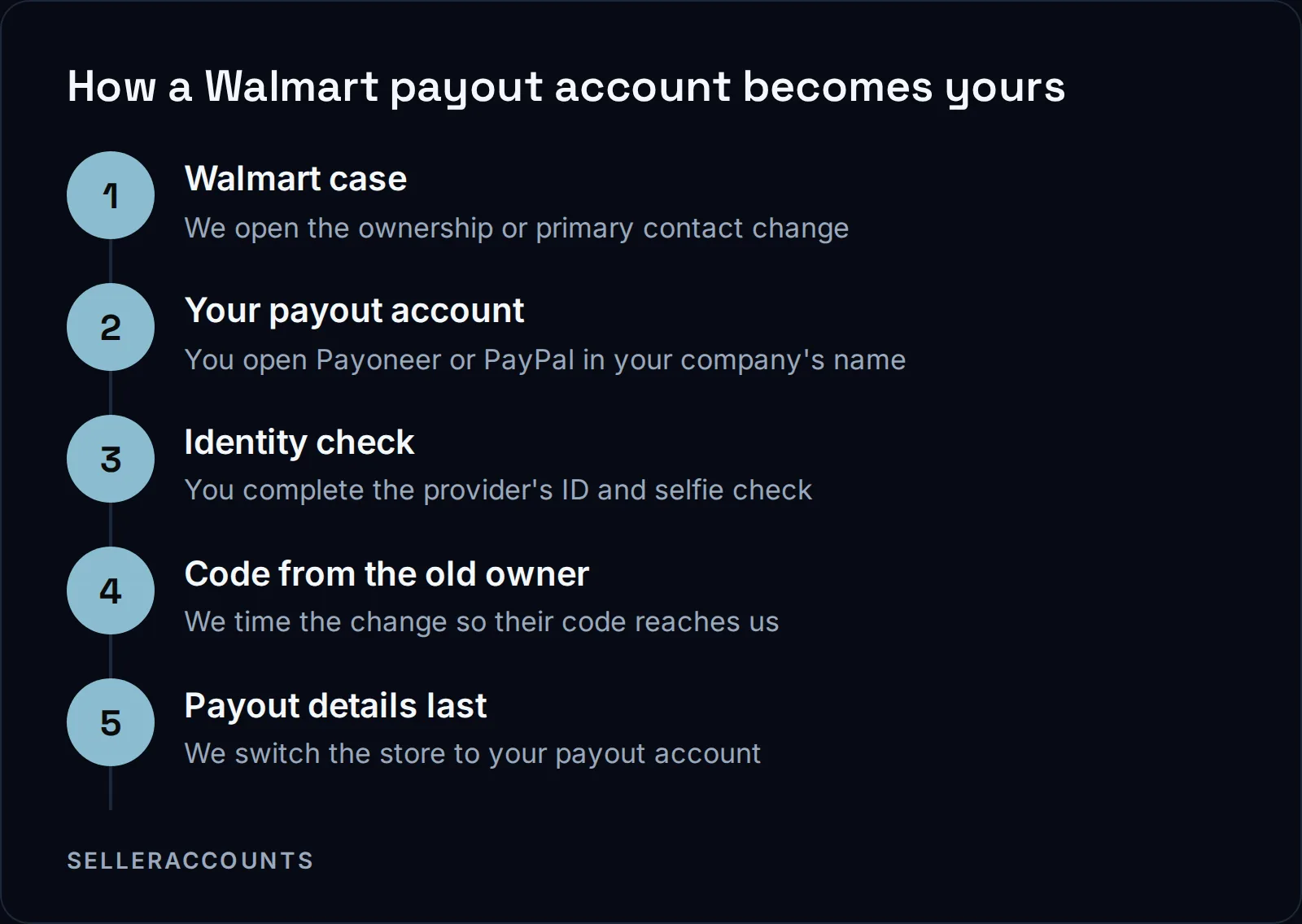
The payout account is always yours, never ours. Walmart sends the verification code to the previous owner, so we agree a time with them and make the change with you on the same call. If Walmart still shows the old payout account afterwards, check the connected apps in Payoneer.
When we quote an account, we give the marketplace, age, sales, feedback and payout type alongside the brand check, so you know how it is paid before you sign. Starting prices are on our price page, and the exact figure for an account comes with its details on the call. The full path is on how buying works, and Walmart stock is on buy Walmart seller accounts.
FAQ
Is Walmart's payout every two weeks the same for every seller?
Walmart says payout generally occurs every 14 days unless other arrangements are made, and your own cut-off sits on the Statements page in Seller Center. New sellers also carry a rolling delay of up to 14 days in the US until the hold's conditions are met.
Does Walmart's new-seller hold differ outside the United States?
Yes, in length. For sellers outside the US, Walmart's new-seller hold policy sets the rolling delay at up to 21 days, against up to 14 days in the US. The release conditions are the same.
Is a high-priced eBay item held longer?
It can be. eBay's Transaction holds page says funds for certain high-priced items are typically held for 31 days after the transaction date. eBay names no threshold for what counts as high-priced.
Can I use eBay funds while they are on hold?
For one thing, yes. eBay says you can use your on hold funds to buy shipping labels on eBay. For most orders, tracking information helps decide when the rest is released.
What if I want to sell a Walmart or eBay store instead of buying one?
That is our sister brand, Cash For Stores (cashforstores.com). They buy Amazon, Walmart and eBay seller accounts from owners leaving the marketplace.
Related pages
Ready to Grow Your Amazon Business?
Book a free demo call and we'll screen-share real accounts live to find the right match for your business. No screenshots, no guesswork.
Book Your Demo