
The Quick Answer
A verified Amazon seller account means Amazon has checked that the person and the business behind it are real: identity, address, bank account, beneficial owner and business documents. For anyone starting an Amazon business, it does not mean the account can sell gated brands, and it does not travel with the account to a new owner. When you take over an aged account from us, we run Amazon's verification again in your company's name and send you a status update every business day.
A verified account is not a product feature. It is a check on whoever owns the account today.
What Does Amazon Check Before an Account Counts as Verified?
Amazon checks four things (identity, address, beneficial owner and business), each confirmed with documents uploaded in Seller Central. In the US, the INFORM Act adds bank, tax ID, email and phone, which Amazon must collect and verify for high-volume sellers.
Here is how Amazon puts the purpose on its global verification page, word for word:
"We must verify the identity of the legal representative or beneficial owner registering the account, and the legitimacy of the business and address information."
A beneficial owner is a person who owns or controls the business behind the account. Amazon's definition, for business sellers:
"A beneficial owner, director, or trustee is a natural person who directly or indirectly owns more than 25 percent of the shares or voting rights of the business, or who owns the business via other means."
The INFORM Consumers Act is a US federal law, in force since June 27, 2023, that makes marketplaces collect and verify information from their high-volume sellers. Under the INFORM Act, a high-volume seller is one with 200 or more sales of new or unused consumer products and $5,000 or more in gross revenue in any continuous 12 months within the previous 24.
People ask about identity, business, bank and tax verification as if they were separate approvals. They are parts of one check. This is what Amazon's pages say each part looks at:
| Check | What Amazon's pages say it covers |
|---|---|
| Identity | Information about the primary contact person and a government-issued photo ID |
| Address | That the business and address information you registered is legitimate |
| Beneficial owner | Anyone owning more than 25 percent, or a senior manager if nobody does |
| Business | Business documents issued by a government-authorized agency within the past 180 days |
| Bank | Bank account information, under the INFORM Act list |
| Tax | A tax identification number, under the same list |
| Contact | A working email address and a working phone number |
The full document list sits in our verification documents checklist, and the INFORM side in our guide to INFORM Act seller verification.
What Verification Does Not Give You
Verification answers one question: is this a real business run by a real person? Everything that makes an account worth having sits outside it.
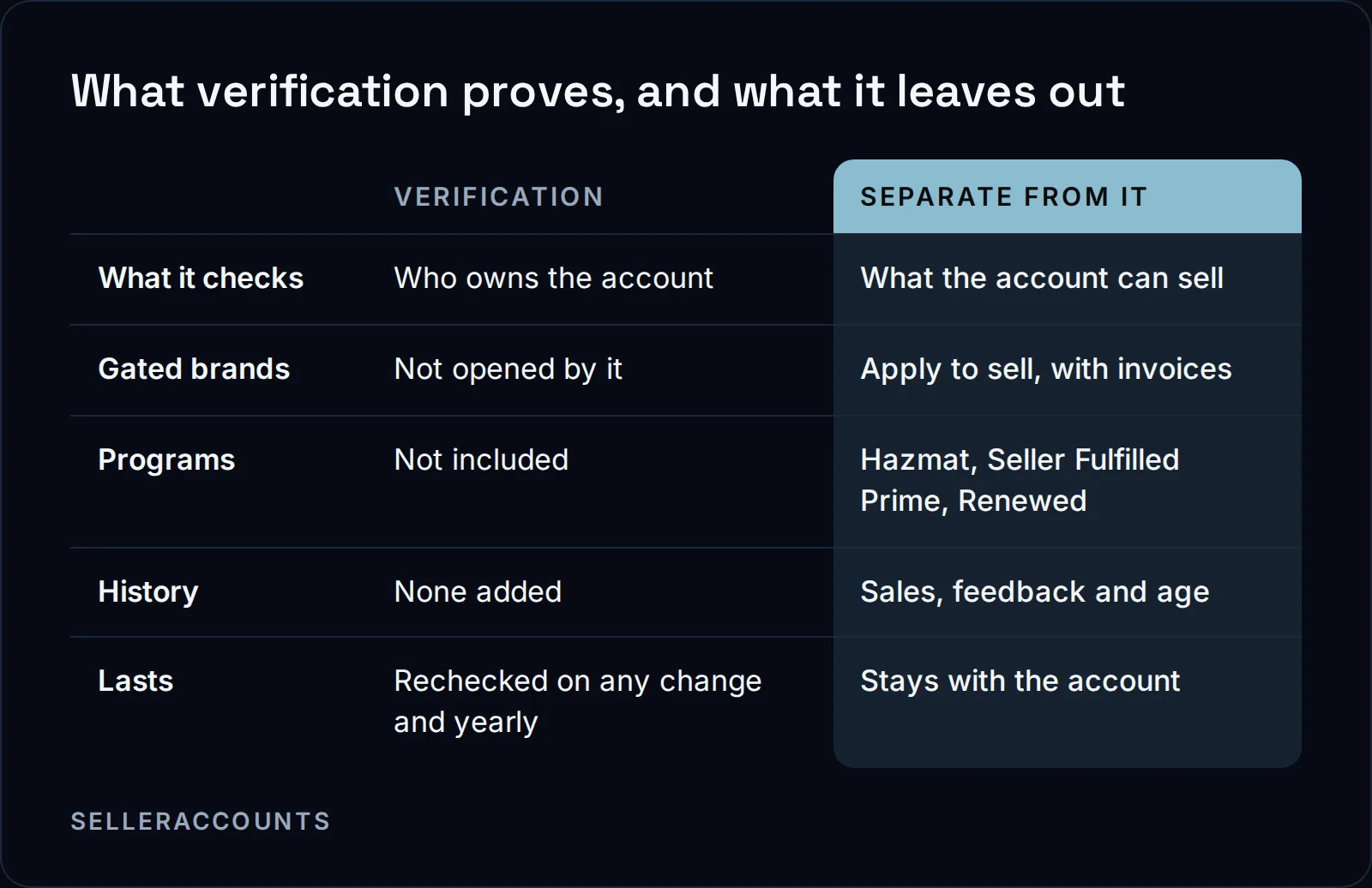
Three things verification does not do:
Gated brands and categories. A brand that shows "apply to sell" still needs an application with invoices before you can list it, verified or not. Our guide to what apply to sell means walks through it.
Restricted programs. Hazmat, Seller Fulfilled Prime and Amazon Renewed each have their own entry rules. Passing identity checks does not enroll you in any of them.
A public badge. What Amazon's INFORM page describes is a seller profile page on Amazon.com with the seller's name, address, an optional customer service phone number and a link to Buyer-Seller Messaging.
Where Do You See That Your Amazon Seller Account Is Verified?
Seller Central shows a confirmation message once you have uploaded every document and piece of information. Amazon says it may contact you within two business days if it needs clarification, and it keeps you informed by email at the address you registered with. The pages we checked name no badge or status label beyond that.
So two places matter: your Seller Central screen, and the inbox on the account. If that inbox belongs to someone who left the business, fix that first.
If verification or the yearly certification is never finished, Amazon's INFORM page says the account can be deactivated. The way back it gives is "Reactivate your account" at the top of the Account health page in Seller Central.
Does Verification Last Forever?
No. Amazon says that if it has already verified your information and nothing has changed, you do not need verifying again. But under the INFORM Consumers Act, high-volume sellers must keep their details current and tell Amazon when they change, and Amazon must verify every update. It also asks them to certify their information at least once a year.
From Amazon's About the INFORM Consumers Act page:
"We must verify your information anytime your information changes, and at least annually to certify that your information is current."
What happens when you move, switch banks, change the legal entity or bring in a new owner? Each of those changes the information Amazon verified, so each one means verifying again. Amazon's pages do not list a separate procedure for each kind of change; your Seller Central screen shows what it asks for.
Can You Buy a Verified Amazon Seller Account?
You can buy an aged Amazon account, but not the previous owner's verification. Verification is tied to the person and business that own the account, so when ownership changes, every verified detail is checked again in the new owner's name. What you buy is the history and approvals. The verification is redone in your name.
If an account is sold as "verified" and the verification still sits on someone else's name and bank, nothing about it is yours. We do not hide the ownership change from Amazon. Passing that verification is the core of the transfer.
10 to 14 days
standard handover, in business days
1 in 2
about how many transfers get an extra verification request
30 to 60 days
total handover when Amazon asks for that extra check
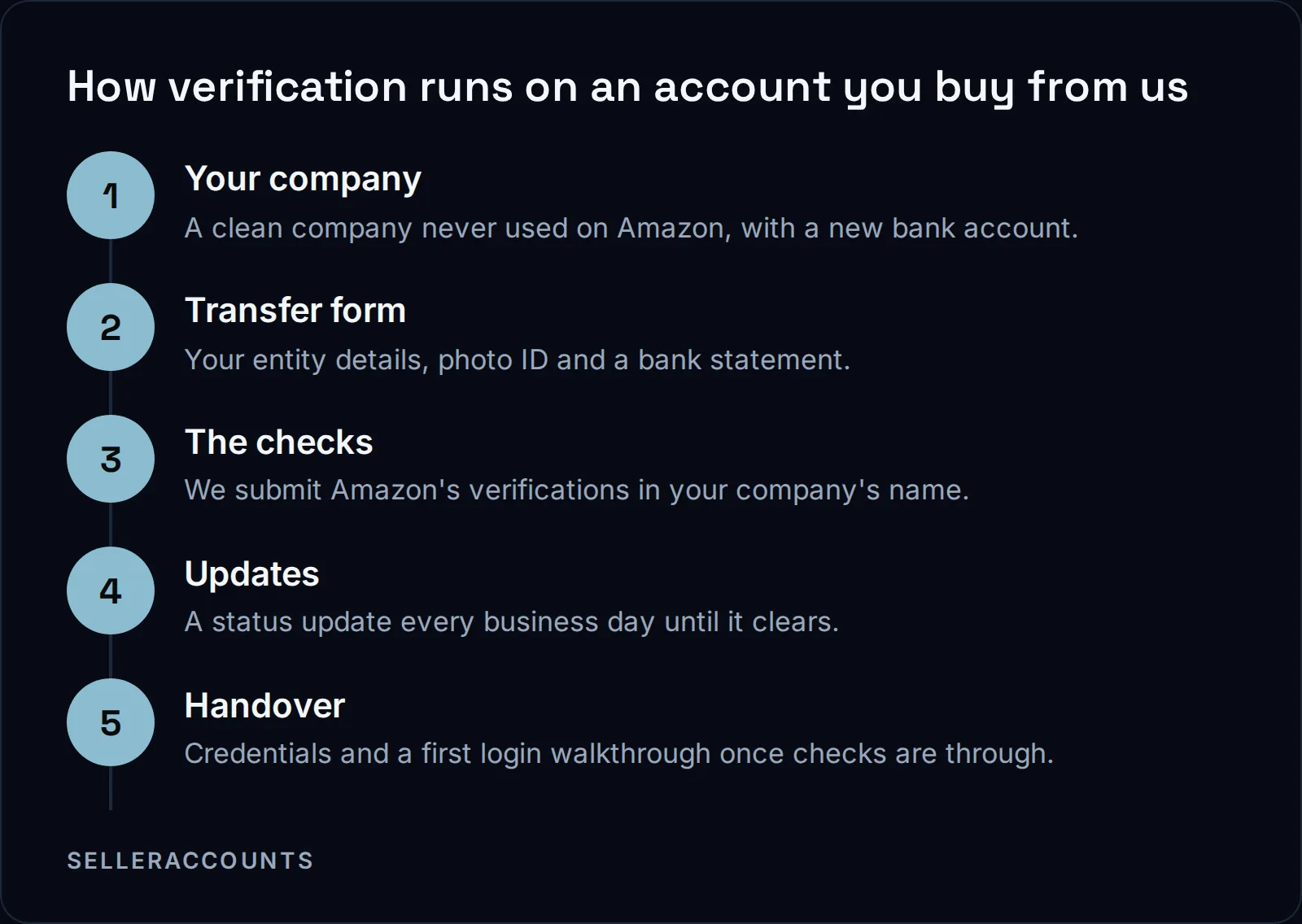
The account number on the bank statement has to match the new bank account you give on the transfer form, and a statement can look perfect and still come back for that. Our guide to a rejected bank statement covers the fixes. If Amazon asks for a live call, see our video verification guide.
Verifying a new account and taking over an aged one, side by side:
| Verifying a new account yourself | Taking over an aged account from us | |
|---|---|---|
| Verification | Yours to run and to chase | Still required, run by us in your company's name |
| Progress | Your own Seller Central screen | A status update every business day |
| Brand approvals | None until you apply | Three brand approvals (apply-to-sell brands we get approved for you), each named in the Deal Agreement, plus any the account already holds |
| Restricted programs | Qualify from zero | Named only where that account's record carries them |
| History | None | The account's own sales and feedback, shown live on the demo |
| After delivery | On your own | Support until 30 days after delivery or your first sale, whichever comes first |
The Deal Agreement is the contract you sign with us before any money moves. An aged account often already holds dozens of brand approvals from its own history, and we show them live on the demo before you buy, never as a number promised for every account. The accounts are on aged Amazon accounts for sale, and the full path is on how buying works.
FAQ
Is my Amazon seller account verified?
Check where you are in registration. On Amazon's registration guide, "Verify your identity" is step 5 of 5, after business, seller, billing and store information. If that step is still open in Seller Central, the account is not verified yet.
Is a verified account the same as a healthy account?
No. Account health is tracked separately, as the Account Health Rating on the Account Health page in Seller Central. Amazon describes it as a score from 0 to 1,000 that shows the account's risk of deactivation for policy violations.
Does verification let me sell gated brands?
No. Each gated brand still needs its own apply-to-sell application with invoices, or you buy an aged account that already holds the approval. If you are looking at one of our accounts, send us the brands or product codes you care about and we check each one against that account.
I want to sell my verified account, not buy one. Who do I talk to?
That is our sister brand, Cash For Stores (cashforstores.com). They buy Amazon, Walmart and eBay seller accounts from owners leaving the marketplace.
Related pages
Ready to Grow Your Amazon Business?
Book a free demo call and we'll screen-share real accounts live to find the right match for your business. No screenshots, no guesswork.
Book Your Demo