
The Short Answer
Not always. For Amazon brand approval you need either a purchase invoice from a manufacturer or distributor, or a brand authorization letter, so a letter of authorization is one of two ways in, not the only one.
When you do send a letter, it has to come from the company that holds the rights to the brand. Nobody else can write it for you, and that includes us.
- Gated means Amazon requires approval before an account can list a brand, a category or a product.
- Brand approval is the application Amazon reviews before a gated brand opens on your account.
- LOA is short for letter of authorization, the document this post is about.
We sell aged Amazon seller accounts, 1,700+ since 2020. Amazon's rules below come from Amazon's own pages, linked where we use them, and where we add our own experience we say so.
What Is a Letter of Authorization on Amazon?
A letter of authorization, or LOA, is written permission from the owner of a trademark, design patent or copyright that lets another business use that property. Amazon's own help page treats it as a license agreement between the rights owner, the licensor, and the seller, the licensee, and it is reviewed as proof you may sell the brand.
Amazon's Letter of authorization page defines it like this:
"A letter of authorization is a license agreement that is entered into between an owner of a trademark / design patent / copyright and a third party to authorize that third party (licensee) to use the intellectual property, in exchange for consideration. Such an agreement outlines the ways in which the licensee may use the property owned by the licensor."
So ask the brand to write it as permission to use the brand's property, not as a friendly note.
When Does Amazon Ask for a Letter of Authorization?
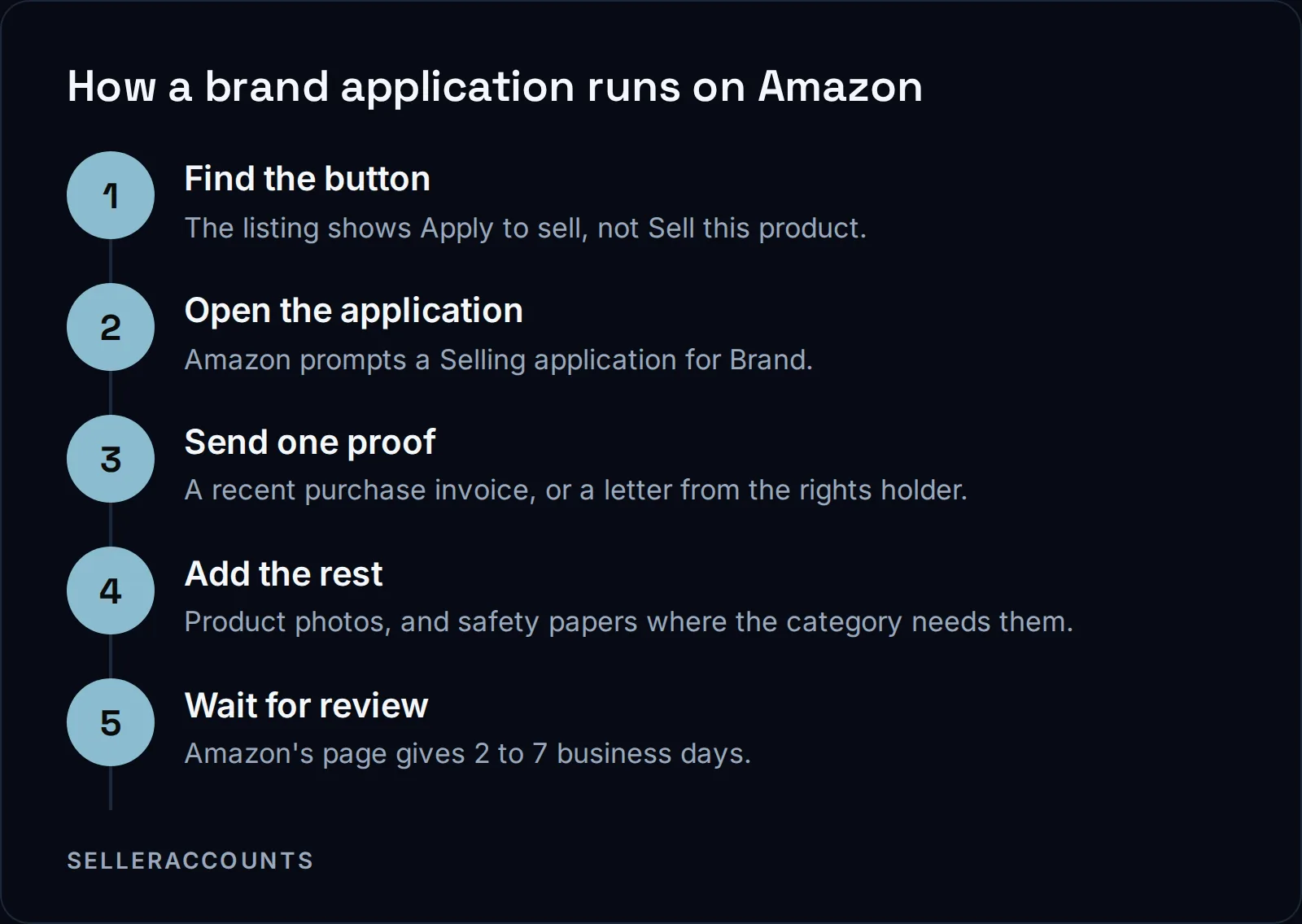
Amazon asks for one in two places. When you apply to sell a gated brand, the Selling application for Brand asks for a purchase invoice from a manufacturer or distributor, or a brand authorization letter. When Amazon takes enforcement action, an appeal typically needs invoices or letters of authorization.
The first case is the one this post is about. Amazon's guide 3 ways to sell branded products on Amazon describes it:
"If the product requires brand approval, you’ll be prompted to complete a Selling application for Brand. This application will guide you through the process of providing information and materials that can help us understand what you want to sell, as well as your relationship to the brand and products. As part of the process, you will need to provide a purchase invoice that you received from a manufacturer or distributor, or a brand authorization letter."
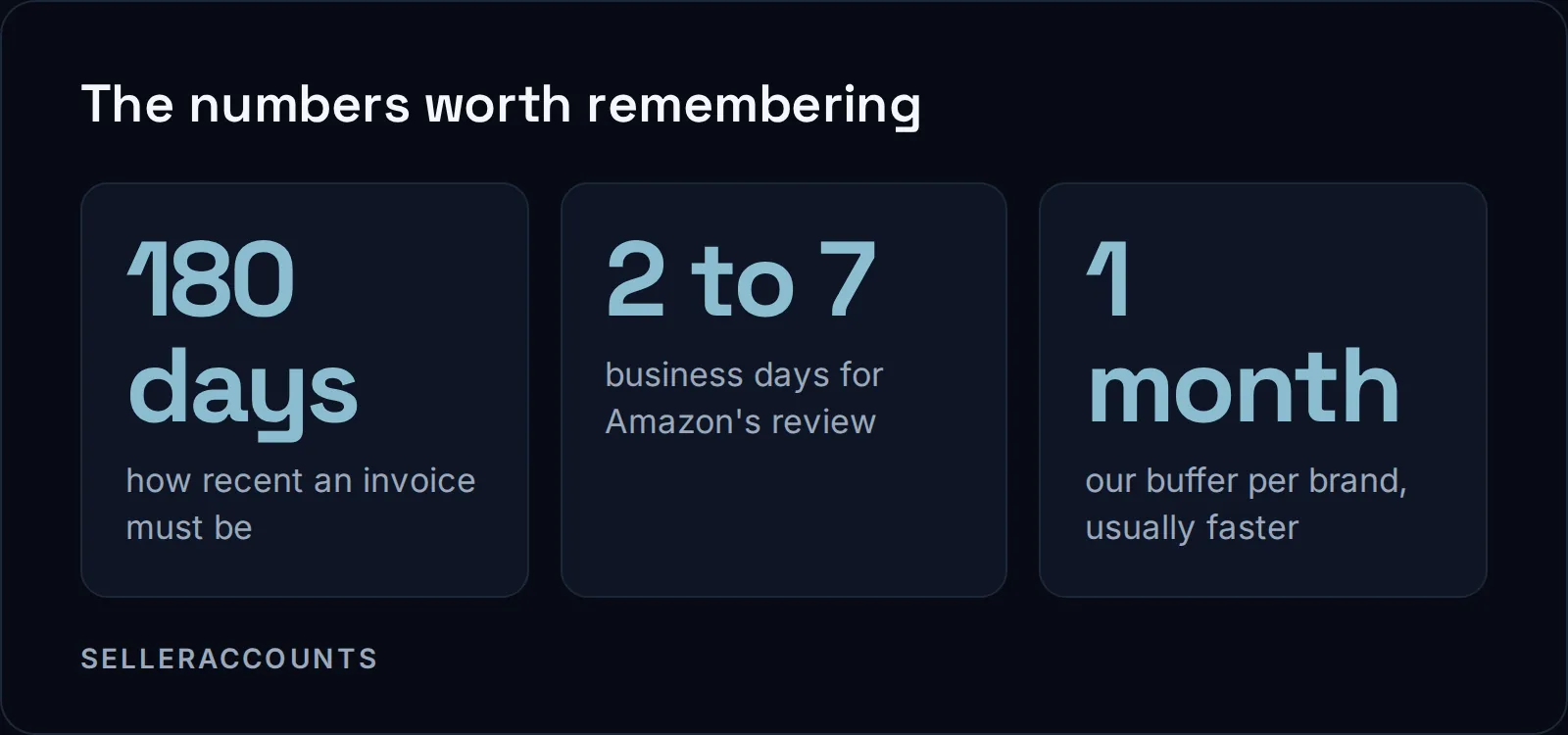
Amazon's approval page lists the same letter among the items to prepare, marked "if applicable", next to purchase invoices dated within 180 days, clear photos of the product from all sides, and safety certifications when required.
The second case is an appeal. Amazon's LOA page says that when the products are confirmed to be genuine, Amazon removes the enforcement claims from your account, and that the Account Health dashboard gives the steps for each type of violation. Appeals are not work we take on, so we say no more about them here.
Who Can Sign a Letter of Authorization?
Amazon's page asks for the letter from the relevant intellectual property owner, on letterhead from the company holding rights to the protected brand. So the signer Amazon describes is the trademark owner. Amazon's page does not say whether a letter from an authorized distributor is accepted in its place, and we would not assume it is.
"In this situation you may be asked to submit either proof of ownership of the trademark, or a letter of authorization from the relevant intellectual property owner to use their registered trademark. This page will help you understand what we expect to see on the letter of authorization you provide."
Distributors do have a place in Amazon's rules, just through a different document. The brand application takes an invoice from a manufacturer or distributor. And Amazon's help page on error 18077 asks you to confirm a legitimate relationship with the brand owner, manufacturer or authorized distributor, backed by invoices, letters of authorization or distribution agreements.
So if your supplier is a distributor, the invoice it sends you is usually the document that fits. If the letter is what you want, ask who owns the trademark and get it from them. A template you fill in yourself is not a letter from the rights holder.
What Does Amazon Expect to See on the Letter?
Amazon's page names the parties first: the licensor, the company or brand giving the rights, and the licensee, the company receiving them. It wants letterhead from the rights holder, and as formats it lists PDFs, scanned PDFs, Word files and screenshots of email sent from the brand's own domain. A self declaration only counts from the owner.
What Amazon's page carries, in short:
| Check | What Amazon's LOA page says |
|---|---|
| Licensor | The company or brand providing the rights |
| Licensee | The company or brand receiving the rights |
| Letterhead | From the company holding rights to the brand |
| File formats | PDF, scanned PDF, Word, or email screenshots from the brand's domain |
| Self declaration | Only acceptable if you are the IP owner |
The licensor and licensee lines in the table come from Amazon's list headed "Specific clauses to be kept in mind while obtaining a letter of authorization". Read that list on Amazon's LOA page before the brand signs anything.
Two things sellers ask about that Amazon's page does not cover:
- The exact wording for selling on Amazon.com. We would not trust any template that claims to have a sentence you must copy.
- Which account fields must match. The page does not list which fields on the letter must match your account.
What If You Own the Brand?
If the brand is yours, you are the one who signs, or you skip the letter. With a registered trademark you can enroll in Brand Registry. Without one, Amazon's guidance points to the Selling application for Catalog Authorization, which you reach from error code 5665, and which lets you list under an unregistered brand name.
Brand Registry is Amazon's program for trademark owners. Amazon's error 18077 page says enrolling, with proof of trademark registration, lets you manage who can sell under your brand name.
For a brand without a trademark, Amazon says this:
"If you want to sell your brand’s products with Amazon, but your brand isn’t enrolled in Brand Registry, you can submit an application to Amazon to request approval to list using an unregistered brand name. This method can work if you don’t have a trademark."
Amazon adds that once the Catalog Authorization application is approved, you can list that product and future products under the unregistered name. A self declaration is acceptable only from the IP owner, so as the owner you can speak for yourself. A reseller cannot.
Invoice or Letter: Which Should You Send?
Send what you actually hold. Amazon's brand application takes either a purchase invoice from a manufacturer or distributor, or a brand authorization letter, so you do not need both. A reseller buying from a distributor holds invoices; a letter makes sense when the brand itself has agreed in writing that you may sell its products.
| Purchase invoice | Letter of authorization | |
|---|---|---|
| Issued by | A manufacturer or distributor | The company holding rights to the brand |
| Amazon's date rule | Dated within 180 days, per the approval page | Amazon's LOA page gives no age |
| What it shows | You bought real stock | The brand lets you use its name |
| Who usually has one | Wholesale and distributor buyers | Sellers with a direct deal with the brand |
| Name on it | The company registered on the seller account, in our experience | The licensee, which is you |
| Where Amazon names it | Approval page and brand application | Approval page, brand application and LOA page |
Either way, a letter or an invoice is not approval by itself. Amazon's FAQ says it may not accept applications for every product it restricts, and its approval page says a reply of "Your account does not qualify" cannot be appealed. One listing can also need more than one approval: Amazon's own example is Nike shoes, which need Shoes category approval and Nike brand approval.
If you are not sure a brand is gated on your account, start with how to check if a brand is gated. If an application already came back declined, read why Amazon keeps declining your ungating application.
What This Means If You Buy an Aged Account
There are two ways to open a gated brand. The slow way is the one above: a supplier relationship, recent invoices or a letter from the brand, then Amazon's review, one brand at a time. The other is an account that already holds the approval.
An aged Amazon seller account is often already ungated, for dozens of brands, shown live on a screen share before you buy. Already ungated means the account can list in that brand today, with no letter and no invoice.
Here is how it works with us:
- Send us your brand list first. A spreadsheet or plain text works. We check each brand against the real account and mark it already ungated or apply to sell.
- Three brand approvals come with every account we sell. Those three are apply to sell, not already ungated. We do the application work, with invoices in the account's registered company name, and each brand is named in your Deal Agreement.
- We plan on one month for one brand. It is usually faster. The month is there so nobody panics if the first attempt is not approved.
- Other approvals are account specific. Hazmat, Seller Fulfilled Prime or Amazon Renewed are named only where that account's record carries them.
Starting prices are on our price page; the figure for a specific account comes with its details, on the call. The full process is on how buying works.
If you want to sell an account rather than buy one, that is our sister brand, Cash For Stores.
FAQ
Can I use a letter of authorization template from the internet?
A template is only a layout. The letter counts when the company holding the brand's rights issues it, and Amazon accepts a self declaration only from the IP owner. A letter you draft and sign yourself for someone else's brand does not meet that.
Do I need permission to sell a brand on Amazon?
Sometimes. Amazon says you may need permission from a brand or from Amazon first, depending on the product type, its condition and your relationship to the brand. Check the listing: Apply to sell means approval is required.
Can a distributor give me a letter of authorization?
Amazon's LOA page names only the intellectual property owner as the source of the letter, and it does not say a distributor's letter is accepted. Amazon's brand application already accepts a purchase invoice from a distributor, dated within 180 days per the approval page, so ask the distributor for that.
Does a letter of authorization mean Amazon will approve me?
No. Amazon may not accept applications for every product it restricts, and its approval page says a "Your account does not qualify" reply cannot be appealed. One listing can also need both a category approval and a brand approval: Amazon's example is Nike shoes, which need Shoes category approval and Nike brand approval.
How long does brand approval take with a letter?
Amazon's approval page gives 2 to 7 business days, and we plan on one month per brand. The detail is in how long Amazon ungating takes.
Related pages
Ready to Grow Your Amazon Business?
Book a free demo call and we'll screen-share real accounts live to find the right match for your business. No screenshots, no guesswork.
Book Your Demo